

Views: 0
How Motorcycle Quickshifters and Slipper Clutches Work
Modern motorcycles use advanced transmission technologies to make riding smoother, faster, and more controlled. Two of the most important developments are quickshifters and slipper clutches.
Although they serve different purposes, both systems improve the interaction between the motorcycle’s engine, gearbox, and rear wheel. Quickshifters help riders change gears with minimal interruption to acceleration, while slipper clutches reduce excessive engine-braking forces during aggressive downshifting.
What Is a Motorcycle Quickshifter?
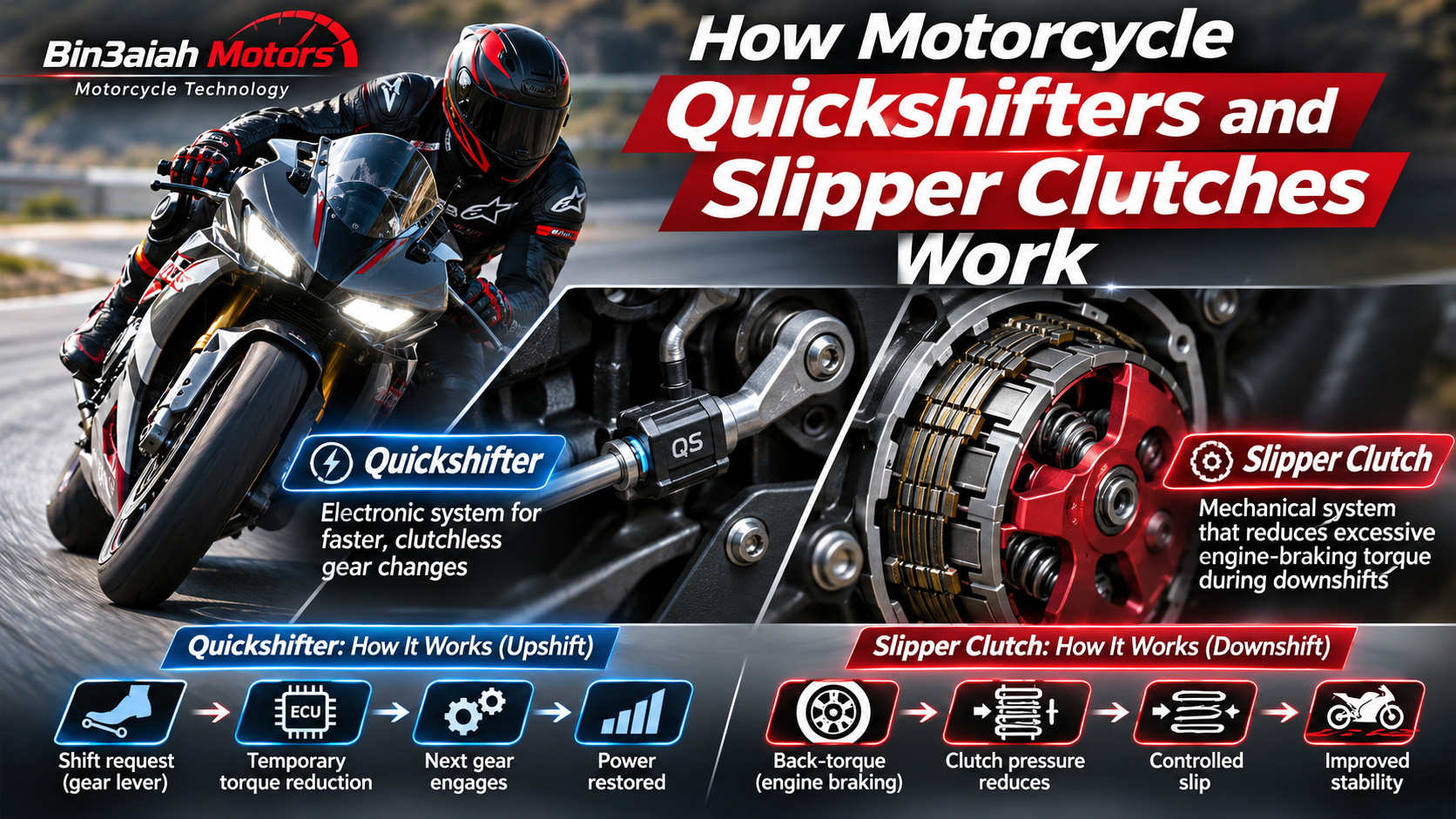
A quickshifter is an electronic system that allows a rider to change gears without manually operating the clutch lever during supported shifts. The system is especially useful when accelerating because it reduces the time required to complete an upshift.

How Does a Quickshifter Work?
Most conventional motorcycle quickshifters use a sensor attached to the gear-shift linkage. When the rider applies pressure to the gear lever, the sensor detects the shift request and communicates with the engine control unit (ECU).
The ECU briefly reduces engine torque, often by interrupting ignition or adjusting fuel delivery. This temporarily unloads the transmission, allowing the next gear to engage without the rider manually pulling the clutch lever.
Quickshifter Operation: Step by Step
- Shift request: The rider presses or lifts the gear lever.
- Sensor activation: A shift sensor detects the movement or applied force.
- ECU intervention: The motorcycle temporarily reduces engine torque.
- Gear engagement: The unloaded transmission allows the selected gear to engage.
- Power restoration: The ECU restores engine torque, allowing acceleration to continue.
The complete process can happen in just a few milliseconds. The precise interruption duration depends on the engine, gearbox, operating conditions, and manufacturer’s calibration.
Types of Motorcycle Quickshifters
1. Upshift-Only Quickshifter
An upshift-only quickshifter allows clutchless gear changes into higher gears, typically while accelerating. It is particularly beneficial on sport motorcycles, where minimizing interruption to power delivery helps maintain acceleration.
However, downshifting still requires conventional clutch and throttle operation.
2. Bidirectional Quickshifter
A bidirectional quickshifter supports clutchless upshifts and downshifts under specified operating conditions.
During downshifting, the system can automatically increase engine speed using an electronic throttle-blipping function. This helps synchronize engine speed with the lower gear, producing smoother gear engagement.
These systems are commonly referred to as quickshifter and auto-blipper systems.
What Is a Motorcycle Slipper Clutch?
A slipper clutch is a mechanical clutch system designed to reduce excessive reverse torque, also known as back-torque, during aggressive deceleration and downshifting.
When a motorcycle is shifted into a lower gear, the rear wheel may attempt to drive the engine faster than its current speed. The resulting engine-braking force can disturb rear-wheel traction, potentially causing wheel hop, chatter, or skidding.
A slipper clutch reduces these effects by allowing the clutch plates to slip in a controlled manner when back-torque becomes excessive.

How Does a Slipper Clutch Work?
Many slipper clutches use specially shaped ramps or cams within the clutch assembly to control the pressure applied to the clutch plates.
Under normal acceleration, the clutch transmits engine torque through the transmission to the rear wheel.
During aggressive downshifting, excessive back-torque can activate the slipper mechanism. The ramps or cams cause a reduction in the clamping force holding the clutch plates together.
This allows controlled slipping between the plates, reducing the braking torque transmitted from the engine to the rear wheel.
Slipper Clutch Operation: Step by Step
- Downshift: The rider selects a lower gear while decelerating.
- Back-torque develops: The rear wheel attempts to accelerate the engine to match the lower gear ratio.
- Slipper mechanism activates: Internal ramps or cams reduce clutch clamping pressure.
- Controlled slipping: The friction plates slip enough to limit excessive reverse torque.
- Stability improves: Rear-wheel chatter and hopping become less likely.
What Is an Assist-and-Slipper Clutch?
An assist-and-slipper clutch combines two mechanical functions in one assembly.
The assist mechanism increases the clamping force on the clutch plates during acceleration. This allows the manufacturer to use lighter clutch springs, reducing the effort required to operate the clutch lever.
The slipper mechanism reduces clamping pressure during excessive engine braking, allowing controlled clutch slip and limiting back-torque.
This combination benefits both everyday riding comfort and performance-oriented riding.
Quickshifter vs. Slipper Clutch: Key Differences
| Feature | Quickshifter | Slipper Clutch |
|---|---|---|
| Primary purpose | Faster gear changes | Limit excessive back-torque |
| Technology | Electronic engine control | Mechanical clutch mechanism |
| Upshifting | Enables supported clutchless shifts | Operates as a normal clutch |
| Downshifting | Auto-blipping on bidirectional systems | Reduces excessive engine-braking torque |
| Main benefit | Shift convenience and acceleration continuity | Improved rear-wheel stability |
Why Do Performance Motorcycles Use Both Systems?
Modern performance motorcycles often combine quickshifters with slipper clutches because the technologies address different stages of riding.
During acceleration, the quickshifter allows the rider to change into higher gears with minimal disruption to power delivery.
When approaching a corner, a bidirectional quickshifter can help match engine speed during downshifting, while the slipper clutch reduces excessive back-torque if a speed mismatch remains.
Together, these systems improve convenience, drivetrain smoothness, and control. However, they do not replace proper gear selection, braking technique, or attention to road conditions.
Are Quickshifters Useful for Everyday Riding?
Quickshifters are not limited to racing motorcycles. They can also improve convenience on touring, adventure, and street motorcycles.
However, some systems operate best above particular engine speeds or under specific throttle conditions. Shifts at low speeds may be less smooth, depending on the motorcycle.
Riders should consult their motorcycle’s owner’s manual to understand when clutchless shifting is supported.
Do Slipper Clutches Improve Motorcycle Safety?
A slipper clutch can improve rear-wheel stability when aggressive downshifting creates excessive engine-braking torque.
It is particularly helpful when approaching corners or braking firmly before a turn.
Nevertheless, a slipper clutch cannot guarantee traction, prevent every rear-wheel slide, or protect the engine from every incorrect downshift. It should be considered a riding aid rather than a substitute for safe riding technique.
Frequently Asked Questions
Can You Use a Quickshifter Without a Slipper Clutch?
Yes. A quickshifter and a slipper clutch are independent technologies. A motorcycle can have either system, both systems, or neither.
Does a Quickshifter Damage the Gearbox?
A properly designed and correctly operated quickshifter is intended to work with the motorcycle’s transmission. However, forcing shifts outside the manufacturer’s recommended operating conditions can cause mechanical stress or poor gear engagement.
Does a Slipper Clutch Make Downshifting Automatic?
No. A slipper clutch does not select gears or automatically match engine speed. It mechanically limits excessive reverse torque. An electronic auto-blipper serves a different function by adjusting engine speed during supported downshifts.
Do You Still Need the Clutch Lever?
Yes. Most motorcycles with quickshifters still require clutch operation when starting, stopping, and during shifts not supported by the quickshifter system.
Conclusion
Quickshifters and slipper clutches have become important parts of modern motorcycle engineering.
A quickshifter electronically manages engine torque to make supported gear changes faster and more convenient. A slipper clutch mechanically limits excessive reverse torque to reduce the risk of rear-wheel instability during aggressive deceleration.
When combined, these technologies can make a motorcycle smoother, more comfortable, and more controlled, both on the road and on the racetrack.
Technical Sources and Further Reading
- Kawasaki – Quickshifter and Assist & Slipper Clutch Technology
- Yamaha Motor – Assist & Slipper Clutch Explained
Published by Bin3aiah Motors – Motorcycle Technology and Engineering.