


Views: 0
How Motorcycle Electronic Suspension Systems Work
Electronic suspension has transformed the way modern motorcycles respond to different riding conditions. Instead of relying entirely on manually adjusted forks and shock absorbers, advanced systems use sensors, electronic controllers, and adjustable damping valves to improve comfort, handling, and stability.


1. What Is Electronic Motorcycle Suspension?
Every motorcycle suspension system uses springs to support the motorcycle and dampers to control suspension movement. The springs compress and extend as the wheels encounter bumps, while hydraulic damping prevents excessive bouncing and oscillation.
On conventional suspension, adjustments to spring preload, compression damping, and rebound damping are generally made manually. Electronic suspension replaces some of these manual adjustments with electrically operated mechanisms.
There are two major categories:
- Electronically adjustable suspension: The rider selects settings using switches or a dashboard menu, and electric actuators adjust the suspension.
- Semi-active suspension: The motorcycle continuously processes sensor data and automatically changes damping resistance while riding.
2. How Electronic Suspension Works
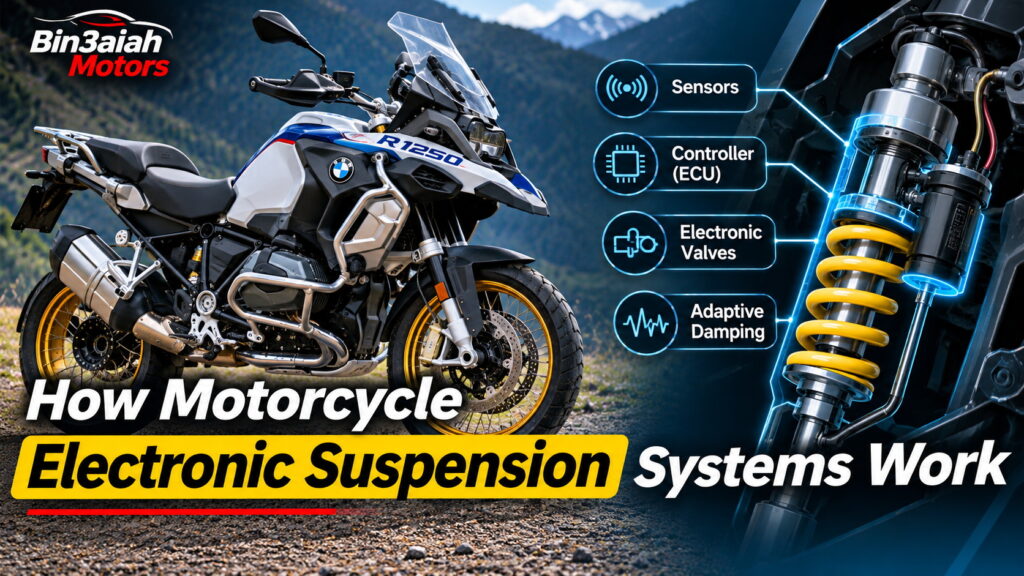
Advanced semi-active suspension systems operate through a continuous feedback process.
- Sensors collect information: Sensors measure variables such as suspension movement, acceleration, wheel speed, and braking input.
- The controller processes the signals: An electronic control unit evaluates the information and selects suitable damping settings.
- Electronic valves respond: Actuators change the flow of hydraulic oil inside the fork or rear shock absorber.
- Damping is adjusted: The suspension changes its resistance to compression and rebound according to the motorcycle’s movement.
This process may repeat many times every second. The response time and precise control strategy depend on the manufacturer and suspension design.


3. The Role of Sensors
Electronic suspension depends on accurate information about the motorcycle’s movement. Depending on the system, the controller can receive information from several sensors:
- Suspension travel sensors: Measure suspension displacement and movement.
- Accelerometers: Detect acceleration and vertical chassis or wheel movement.
- Inertial measurement units: Measure angular motion and acceleration to help assess chassis behavior.
- Wheel-speed sensors: Measure rotational speed at the wheels.
- Brake-pressure sensors: Identify braking demand.
- Throttle and engine signals: Provide additional information about acceleration and rider inputs.
During braking, for example, the motorcycle transfers load toward the front wheel. An advanced suspension controller can respond by modifying fork damping to manage the rate of compression and reduce excessive chassis movement.
4. Compression and Rebound Damping
Understanding the two main damping directions helps explain how electronic suspension works.
Compression Damping
Compression damping controls how quickly the suspension compresses when the wheel moves upward relative to the chassis. More damping resistance can reduce rapid suspension movement, while less resistance allows easier compression.
Rebound Damping
Rebound damping controls how quickly the suspension extends after compression. Appropriate rebound control helps prevent the motorcycle from bouncing repeatedly after a bump.
Electronic damping systems can adjust these characteristics automatically or through selectable settings. Some systems control compression and rebound independently, while others have more limited adjustment capabilities.
5. Electronic Suspension in Real Motorcycles
BMW Motorrad Dynamic ESA
BMW’s Dynamic Electronic Suspension Adjustment technology is used on selected motorcycle models. Depending on the version, it can automatically adapt damping to riding conditions and provide electronic spring preload adjustment.
Its aim is to maintain an appropriate balance between comfort and chassis stability, whether the rider is cruising, accelerating, braking, or carrying additional luggage.
Ducati Skyhook Suspension
Ducati has used semi-active Skyhook suspension on selected Multistrada models. The system uses sensor information to control damping and reduce unwanted chassis movement, helping the motorcycle remain more composed over changing road surfaces.
Honda Showa EERA
Honda’s Showa Electronically Equipped Ride Adjustment system provides electronically controlled suspension on selected Africa Twin models. The system automatically adapts damping and offers selectable characteristics for different riding conditions.


Öhlins Smart EC
Öhlins Smart EC technology is used on selected high-performance motorcycles. It combines electronically controlled damping with software strategies designed to respond to riding events such as braking, accelerating, and cornering.
6. Riding Modes and Automatic Adjustment
Many motorcycles with electronic suspension offer several riding modes. These settings influence the suspension’s behavior based on the desired riding experience.
- Comfort or Touring: Generally emphasizes smoothness and reduced harshness over uneven roads.
- Sport: Typically favors greater damping control during dynamic riding.
- Off-Road: Uses settings suited to rough terrain and changing wheel movement.
- Passenger or Luggage: On supported systems, adjusts rear spring preload to accommodate additional load.
On semi-active systems, selecting a mode generally changes the underlying control strategy rather than simply fixing damping at one constant level.
7. How Electronic Suspension Improves Handling
One major advantage of semi-active suspension is its ability to respond to different motorcycle movements without requiring constant rider adjustments.
During acceleration, the controller may alter rear damping to better manage chassis movement. Under braking, it can adjust the front suspension’s response. When the motorcycle encounters uneven pavement, the damping strategy can help maintain wheel compliance while limiting unwanted movement of the chassis.
These capabilities can make a motorcycle feel more composed across a variety of road conditions, although their effectiveness depends on system calibration, suspension design, and available traction.


8. Advantages and Disadvantages
Advantages
- Automatic adaptation to changing riding conditions.
- Convenient adjustment using dashboard controls.
- Improved management of chassis movement.
- Potential improvements in ride comfort and control.
- Electronic load compensation on supported systems.
Disadvantages
- Higher purchase costs compared with simpler suspension systems.
- Greater electronic and mechanical complexity.
- Potentially higher repair and replacement costs.
- Dependence on sensors, wiring, actuators, and control software.
Electronic suspension does not replace appropriate maintenance, correct spring rates, sound tires, or safe riding technique.
9. The Future of Electronic Motorcycle Suspension
Manufacturers continue to integrate suspension technology with increasingly sophisticated motorcycle control systems. Developments include improved damping strategies, automatic load management, and adjustable ride-height technology.
In November 2026, Honda announced the CRF1150L Africa Twin family with Showa EERA suspension incorporating Honda Skyhook control on selected versions. This illustrates how electronic suspension is evolving toward more integrated management of motorcycle dynamics.
Conclusion
Motorcycle electronic suspension systems combine conventional springs and hydraulic dampers with electronic sensors, actuators, and intelligent control software. While simpler systems make adjustments more convenient, advanced semi-active systems continuously modify damping according to the motorcycle’s behavior.
For riders, the most important benefit is adaptability: a motorcycle can deliver a comfortable ride over uneven pavement while providing greater chassis control during demanding riding situations.
As the technology develops, electronically controlled suspension is becoming an increasingly important part of modern motorcycle engineering.
Technical References
- Bosch Mobility — Semi-Active Damping Control
- Honda Global — 2026 Africa Twin Technology Announcement
- Honda Motorcycles — Africa Twin EERA Suspension
Photography sourced from Wikimedia Commons with attribution as shown in each caption. Images are used to illustrate motorcycle and suspension technology; they do not necessarily depict the exact electronic suspension hardware discussed. Creative Commons ShareAlike requirements apply to adapted images.