


Views: 0
Motorcycle Cornering ABS and Traction Control Explained
Modern motorcycles are equipped with increasingly advanced electronic safety systems designed to improve stability during braking, acceleration, and cornering. Two of the most important technologies are Cornering ABS and motorcycle traction control.
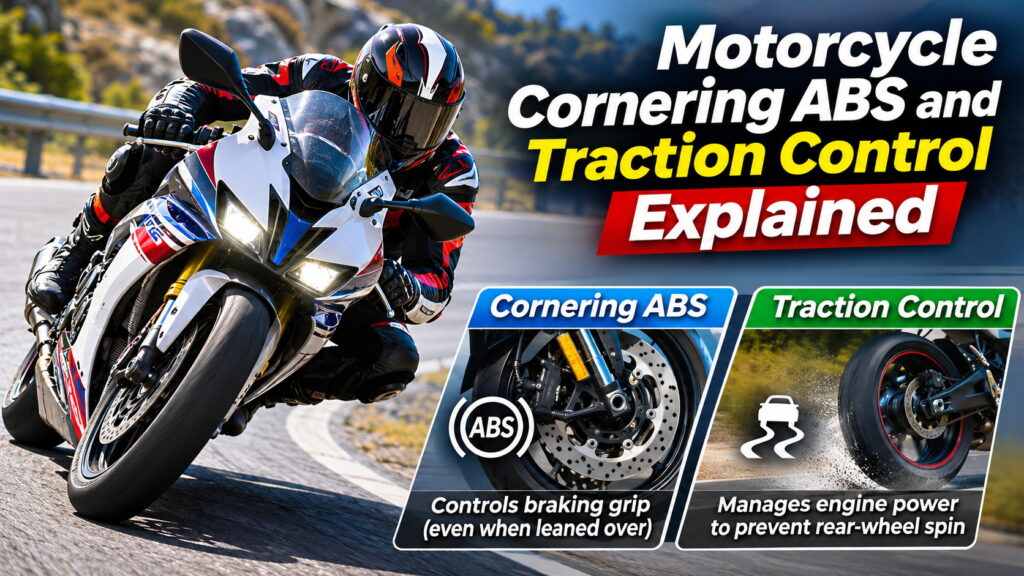
Although both systems manage tire grip, they perform different functions. Cornering ABS controls braking pressure to help prevent wheel lock and instability, while traction control regulates engine torque to limit excessive rear-wheel spin.


What Is Motorcycle Cornering ABS?
Traditional Anti-lock Braking Systems (ABS) monitor front and rear wheel speeds and adjust hydraulic brake pressure when a wheel approaches lockup. This helps riders maintain control during hard braking.
Cornering ABS adds another layer of intelligence. By using motorcycle movement data, it can adapt braking intervention when the motorcycle is leaned over.
This is important because tires have a limited amount of available grip. When a motorcycle is turning, some of that grip is already being used to generate cornering forces. Applying the brakes introduces additional demands on the tires.
Cornering ABS helps manage these competing forces by adjusting brake pressure according to the motorcycle’s dynamic condition.
How Cornering ABS Works
Advanced motorcycle stability systems combine information from several components:
- Wheel-speed sensors: Monitor the rotational speed of the front and rear wheels.
- Inertial Measurement Unit (IMU): Measures movement and angular rotation.
- Electronic control unit: Processes sensor data and determines appropriate intervention.
- Hydraulic ABS modulator: Regulates brake pressure when necessary.
When braking in a corner, the system evaluates the motorcycle’s movement and wheel behavior. If a wheel approaches lockup, the ABS controller can reduce or regulate braking pressure to help maintain stability.


The Role of the Inertial Measurement Unit
One of the most important components in advanced motorcycle safety electronics is the Inertial Measurement Unit (IMU).
A six-axis IMU typically measures angular movement around three axes and linear acceleration along three axes:
- Roll: Rotation associated with leaning left or right.
- Pitch: Forward or backward rotation, including movement during braking and acceleration.
- Yaw: Rotation around the vertical axis as the motorcycle changes direction.
- Longitudinal acceleration: Forward and backward acceleration.
- Lateral acceleration: Sideways acceleration.
- Vertical acceleration: Upward and downward acceleration.
By processing IMU data alongside wheel-speed information, the electronic controller can estimate the motorcycle’s riding dynamics and adjust stability interventions.
Not every system uses a full six-axis IMU. Manufacturers offer different sensor configurations depending on the motorcycle and the functions included.
What Is Motorcycle Traction Control?
Motorcycle traction control is designed to limit excessive rear-wheel spin during acceleration.
When a rider opens the throttle, engine torque is transmitted to the rear wheel. If the demanded driving force exceeds the grip available from the rear tire, the wheel may begin spinning faster than expected.
Traction control detects indications of excessive slip and reduces engine torque when needed.
Depending on the motorcycle, the system can intervene by adjusting:
- Electronic throttle opening.
- Ignition timing or ignition events.
- Fuel delivery.
- Other electronically controlled engine torque-management functions.
These adjustments help manage rear-wheel grip and maintain more predictable acceleration.
How Cornering Traction Control Is Different
Basic traction control primarily relies on wheel-speed information to detect excessive rear-wheel slip.
More advanced cornering-sensitive traction control also considers the motorcycle’s movement, particularly its lean angle.
When a motorcycle is leaned over, the tires must provide both cornering force and acceleration force. The available grip for acceleration may therefore be lower than when riding upright.
Lean-sensitive traction control adjusts its response according to these conditions.


Cornering ABS vs. Traction Control
| Feature | Cornering ABS | Traction Control |
|---|---|---|
| Main function | Manage braking grip | Manage acceleration grip |
| Primary intervention | Adjust hydraulic brake pressure | Reduce engine torque |
| Typical activation | During braking | During acceleration |
| Primary risk addressed | Wheel lock and braking instability | Excessive rear-wheel spin |
| Lean-angle awareness | Yes | On cornering-sensitive versions |
Why These Technologies Matter in Corners
Imagine approaching a corner and encountering an unexpected obstacle.
If the rider brakes aggressively while leaned over, the tires must simultaneously support cornering forces and braking forces. This can create a challenging stability situation.
Cornering ABS can adjust braking pressure when necessary to help reduce the risk of wheel lock and improve stability.
Similarly, during acceleration out of a corner, traction control can reduce engine torque if the rear tire begins to spin excessively.
Neither system can guarantee that a motorcycle will remain upright. Excessive speed, slippery surfaces, worn tires, or abrupt control inputs can exceed the available grip.
Motorcycle Riding Modes and Electronic Safety
Many modern motorcycles provide selectable riding modes, commonly including Rain, Road, Sport, and Track.
Depending on the model, these settings may influence throttle response, engine output, traction-control sensitivity, and ABS operation.
Rain Mode
Rain mode commonly provides smoother throttle response and more conservative traction-control intervention to help manage reduced grip on wet surfaces.
Road Mode
Road mode typically balances everyday performance with electronic assistance for normal riding conditions.
Sport Mode
Sport mode may provide sharper throttle response and allow more wheel slip before traction-control intervention.
Track Mode
Some performance motorcycles offer track-oriented settings that permit greater wheel slip or modify ABS behavior for closed-circuit riding.
Important: Exact settings vary by manufacturer and motorcycle. Riders should consult the owner’s manual before changing electronic safety functions.
Limitations of Cornering ABS and Traction Control
Despite their sophistication, motorcycle stability systems have important limitations.
- They cannot overcome the physical limits of tire grip.
- They cannot compensate for every riding mistake.
- Road debris, gravel, oil, and standing water can significantly reduce traction.
- Worn or incorrectly inflated tires may reduce system effectiveness.
- Intervention characteristics differ between motorcycle models.
- Safe braking and cornering still require proper rider technique.
The safest approach is to treat these technologies as additional assistance rather than replacements for careful riding.
The Future of Motorcycle Stability Control
Motorcycle electronics continue to evolve as manufacturers develop smaller sensors, faster processing systems, and more sophisticated control algorithms.
Integrated stability platforms can combine cornering brake control, cornering traction control, rear-wheel lift mitigation, engine drag torque management, and other rider-assistance functions.
These capabilities are becoming available across a broader range of motorcycles, including smaller-displacement models.
As the technology develops, riders can benefit from more refined electronic intervention while retaining responsibility for speed, road awareness, and safe motorcycle control.
Conclusion
Cornering ABS and traction control are two important advances in modern motorcycle engineering.
Cornering ABS helps manage braking stability when the motorcycle is leaned over, while traction control helps limit excessive rear-wheel spin during acceleration.
With the assistance of wheel-speed sensors, inertial measurement units, and electronic control systems, motorcycles can respond more intelligently to changing riding conditions.
However, technology cannot replace skill or judgment. Appropriate speed, smooth braking and throttle inputs, and properly maintained tires remain essential to safe riding.
Technical References
Image Credits and Licenses
- Cornering motorcycle photograph: aa20335 / Wikimedia Commons – CC BY-SA 2.0.
- Yamaha R6 front brake photograph: Glen MacLarty / Wikimedia Commons – CC BY 2.0.
- Pikes Peak motorcycle photograph: Hustvedt / Wikimedia Commons – CC BY-SA 3.0.


