


Views: 0
The 10 Most Influential Motorcycles in History
Bin3aiah Motors | Motorcycle History | Legendary Motorcycles


4
Motorcycles have transformed the way people travel, compete, explore, and experience freedom. From early mechanical innovations to modern racing-inspired superbikes, certain motorcycles have left a legacy far greater than their sales figures or horsepower.
Some made personal transportation affordable for millions. Others introduced engineering breakthroughs, created new motorcycle categories, or influenced generations of riders and designers.
Here are 10 of the most influential motorcycles in history, selected for their technological innovation, cultural significance, and lasting impact on the motorcycle industry.
1. 1923 BMW R 32 — The Birth of BMW Motorrad


The BMW R 32 marked BMW’s arrival as a motorcycle manufacturer and introduced a mechanical formula that would define the brand for more than a century.
Designed under the leadership of Max Friz, the R 32 featured a horizontally opposed twin-cylinder boxer engine and a shaft-driven rear wheel. At a time when chain and belt drives were common, BMW’s integrated engineering approach distinguished the motorcycle from many competitors.
Why it changed history: The boxer engine and shaft-drive configuration became core elements of BMW’s engineering identity and helped establish its reputation for long-distance reliability.
BMW Group
+1
2. 1948 Vincent Black Shadow — The Original Speed Legend


The Vincent Black Shadow demonstrated that a production motorcycle could deliver astonishing performance decades before modern superbikes existed.
Its 998cc V-twin engine produced approximately 55 horsepower and could propel the motorcycle to around 125 mph (201 km/h), remarkable performance for the late 1940s.
Vincent also used the engine as a structural component of the chassis, reducing dependence on a conventional full frame.
Why it changed history: The Black Shadow established an enduring benchmark for extreme production-motorcycle performance and influenced the pursuit of speed, power and advanced chassis design.

National Motorcycle Museum
+1
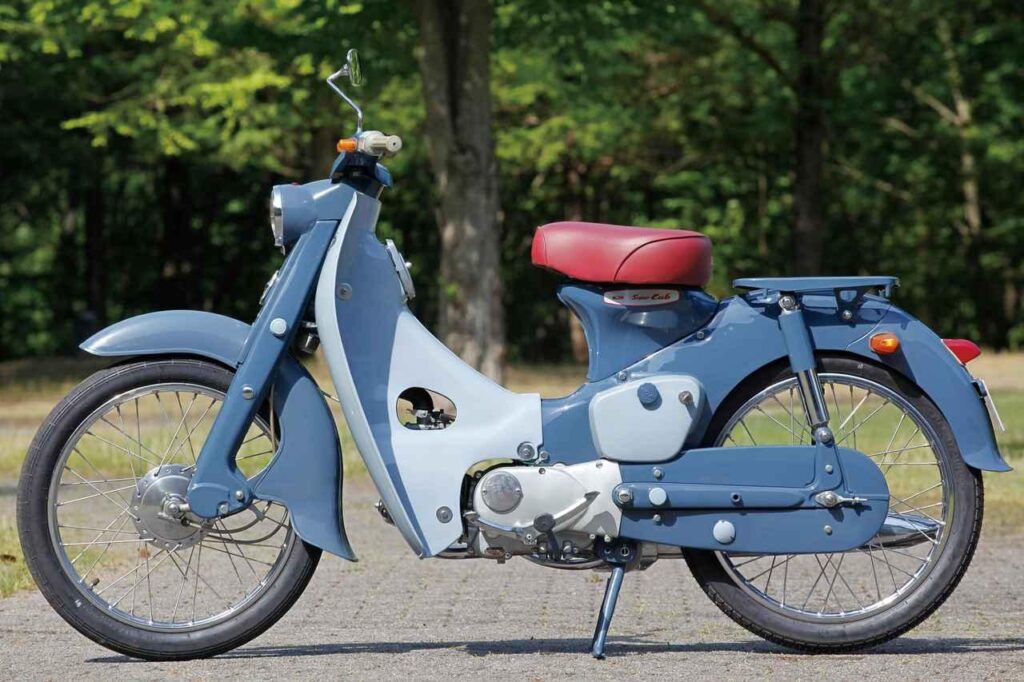
3. 1958 Honda Super Cub C100 — Motorcycling for Everyone


The Honda Super Cub arguably did more to make motorcycling accessible worldwide than any other motorcycle.
Launched with a 49cc four-stroke engine, easy-to-use semi-automatic transmission and practical step-through design, it made daily travel convenient, economical and approachable.
Its influence extended throughout Asia and across global markets, providing transportation for commuters, families, small businesses and delivery workers.
In October 2017, Honda confirmed that cumulative production of the Super Cub series had exceeded 100 million units.
Why it changed history: It transformed the motorcycle from something often associated with enthusiasts into an everyday transportation tool used by millions of people.
Honda Global Corporate Website
+1
4. 1959 Triumph Bonneville T120 — The Icon of British Motorcycling


The Triumph Bonneville T120 became one of the defining motorcycles of the 1960s.
Powered by a 650cc parallel-twin engine and named after the Bonneville Salt Flats in Utah, the Bonneville combined performance, elegant proportions and unmistakable British character.
Its popularity helped shape café racer culture, and it became closely associated with the style and independence of an emerging generation of riders.
Why it changed history: The Bonneville demonstrated that motorcycle design could be as culturally influential as motorcycle engineering. Its legacy continues through Triumph’s modern-classic range.
For the Ride
+1
5. 1968 Yamaha DT-1 — The Motorcycle That Popularized Trail Riding


Before purpose-built dual-purpose motorcycles became widespread, riders often modified road motorcycles to venture onto dirt trails.
The Yamaha DT-1 helped change that.
With a 246cc two-stroke single-cylinder engine, off-road-oriented suspension and block-pattern tires, the DT-1 offered an accessible motorcycle for both paved roads and rugged terrain.
It became especially popular in the United States, where recreational off-road motorcycling was gaining momentum.
Why it changed history: The DT-1 helped establish the trail-bike market, opening the door to generations of dual-sport and recreational off-road motorcycles.
Yamaha Motor Co., Ltd.
+1
6. 1969 Honda CB750 Four — The Birth of the Modern Superbike


The Honda CB750 Four revolutionized the performance motorcycle market and is widely regarded as one of the machines that established the modern superbike.
Its 736cc inline-four engine offered smooth, powerful performance in a production motorcycle. It also featured electric starting and a front hydraulic disc brake, combining performance and usability in a way that changed customer expectations.
Unlike exotic, expensive racing-derived machines, the CB750 brought sophisticated performance to a much broader audience.
Why it changed history: It established a new benchmark for production motorcycle performance, technology and value, influencing the direction of Japanese and international motorcycle development.
Honda Global
+1
7. 1975 Honda Gold Wing GL1000 — Reinventing Long-Distance Touring


The original Honda Gold Wing GL1000 introduced an ambitious vision for long-distance riding.
Its 999cc liquid-cooled flat-four engine, shaft drive and low center of gravity made it remarkably capable on highways. The original GL1000 was not the fully equipped luxury tourer that later generations would become; it began as a powerful, sophisticated road motorcycle.
Owners soon began fitting touring windscreens, luggage and other accessories. Honda responded with increasingly comfortable and fully equipped versions.
Why it changed history: The Gold Wing helped redefine what a dedicated long-distance touring motorcycle could offer, establishing a foundation for the luxury touring category.
Honda Global
+1
8. 1980 BMW R 80 G/S — The Adventure Motorcycle Pioneer


The BMW R 80 G/S introduced a bold idea: a large motorcycle could travel comfortably on highways while remaining capable of navigating unpaved terrain.
Its 797cc boxer-twin engine, shaft drive, long-travel suspension and innovative Monolever rear suspension distinguished it from conventional road motorcycles.
The model’s association with international expeditions and the Paris–Dakar Rally reinforced its adventurous identity.
Why it changed history: It helped establish the large-capacity adventure and travel-enduro segment, influencing motorcycles designed for long-distance exploration across mixed terrain.
100 years of success.
+2
9. 1985 Suzuki GSX-R750 — Bringing Racing Technology to the Road


The Suzuki GSX-R750 changed expectations of what a road-legal sportbike could be.
Inspired by endurance racing, it featured a lightweight aluminum frame, full aerodynamic bodywork and an oil-cooled four-cylinder engine.
Suzuki’s original machine produced a claimed 77 PS and had a dry weight of just 179 kg. Its emphasis on reduced weight, sharp handling and race-inspired ergonomics would help define the next generation of sport motorcycles.
Why it changed history: The GSX-R750 made the race-replica supersport concept a major force in production motorcycling, pushing competing manufacturers toward lighter, sharper and more track-focused machines.
Global Suzuki
+1
10. 1994 Ducati 916 — The Superbike as a Work of Art


The Ducati 916 demonstrated that breathtaking design and competitive performance could exist in the same machine.
Designed by Massimo Tamburini, the 916 became instantly recognizable through its aggressive fairing, twin underseat exhausts, single-sided swingarm and compact, sculptural appearance.
Its 916cc desmodromic V-twin engine delivered distinctive character and impressive performance, while its racing derivatives achieved major success in the World Superbike Championship.
Why it changed history: The 916 elevated motorcycle styling into an important part of superbike identity, proving that visual beauty and racing performance could strengthen one another.
Heritage – update Pan Ann
+1
Comparison: 10 Motorcycles That Changed the Industry
| Motorcycle | Landmark year | Greatest influence |
|---|---|---|
| BMW R 32 | 1923 | Boxer engine and shaft-drive heritage |
| Vincent Black Shadow | 1948 | High-performance production motorcycles |
| Honda Super Cub C100 | 1958 | Accessible mass-market transportation |
| Triumph Bonneville T120 | 1959 | British motorcycle culture and classic styling |
| Yamaha DT-1 | 1968 | Recreational trail riding |
| Honda CB750 Four | 1969 | Modern superbike engineering |
| Honda Gold Wing GL1000 | 1975 | Long-distance luxury touring |
| BMW R 80 G/S | 1980 | Large adventure motorcycles |
| Suzuki GSX-R750 | 1985 | Race-replica supersports |
| Ducati 916 | 1994 | Superbike design and racing identity |
Which Motorcycle Had the Greatest Impact?
The answer depends on how influence is measured.
For global accessibility, the Honda Super Cub stands out. Its enormous production volume and everyday practicality brought personal mobility to generations of riders.
For performance engineering, the Honda CB750 Four transformed expectations of what a mainstream production motorcycle could achieve.
For enthusiast culture and design, the Triumph Bonneville, Suzuki GSX-R750 and Ducati 916 remain defining examples of how motorcycles can inspire entire communities.
All ten motorcycles demonstrate that influence is not simply about maximum horsepower or speed. It is about changing what comes next.
Frequently Asked Questions
What is the most influential motorcycle ever made?
The Honda Super Cub is one of the strongest candidates because of its global reach, accessibility and cumulative production exceeding 100 million units by 2017.
Which motorcycle started the modern superbike era?
The 1969 Honda CB750 Four is widely credited with helping establish the modern superbike category through its powerful inline-four engine and advanced production features.
Which motorcycle helped create adventure touring?
The 1980 BMW R 80 G/S was instrumental in establishing the large-capacity adventure and travel-enduro category.
What makes the Ducati 916 so important?
Its combination of memorable Italian design, innovative engineering and World Superbike success made it an enduring reference point for performance motorcycle design.
Conclusion
Motorcycle history is filled with machines that challenged expectations, but relatively few truly reshaped the industry.
From the revolutionary everyday accessibility of the Honda Super Cub to the aggressive racing technology of the Suzuki GSX-R750, these motorcycles helped define new categories, inspired competitors and influenced the way motorcycles are designed today.
Their greatest achievement was not simply being exceptional machines. It was inspiring the generations of motorcycles that followed.
SEO and publishing package
SEO title
The 10 Most Influential Motorcycles in History | Bin3aiah Motors
URL slug
most-influential-motorcycles-history
Meta description
Discover 10 motorcycles that changed history, from the Honda Super Cub and CB750 to the BMW R 80 G/S, Suzuki GSX-R750 and Ducati 916.
Focus keyword
Most influential motorcycles in history
Secondary keywords
Legendary motorcycles, motorcycle history, iconic motorcycles, classic motorcycles, best motorcycles of all time.
Categories
Motorcycle History, Legendary Motorcycles, Motorcycle Engineering
Suggested featured image
A historical collage featuring the Honda Super Cub, Honda CB750, BMW R 80 G/S and Ducati 916, with accurate model identification and licensed photography.
Publishing status
Article drafted and historical claims sourced. Not published.
Editorial note: The ten selections are an interpretive ranking rather than an official industry ranking. Manufacturer archives and motorcycle museums are used for historical verification. The images above are visual references; confirm usage rights before publishing to motors.bin3aiah.net.