


Views: 0
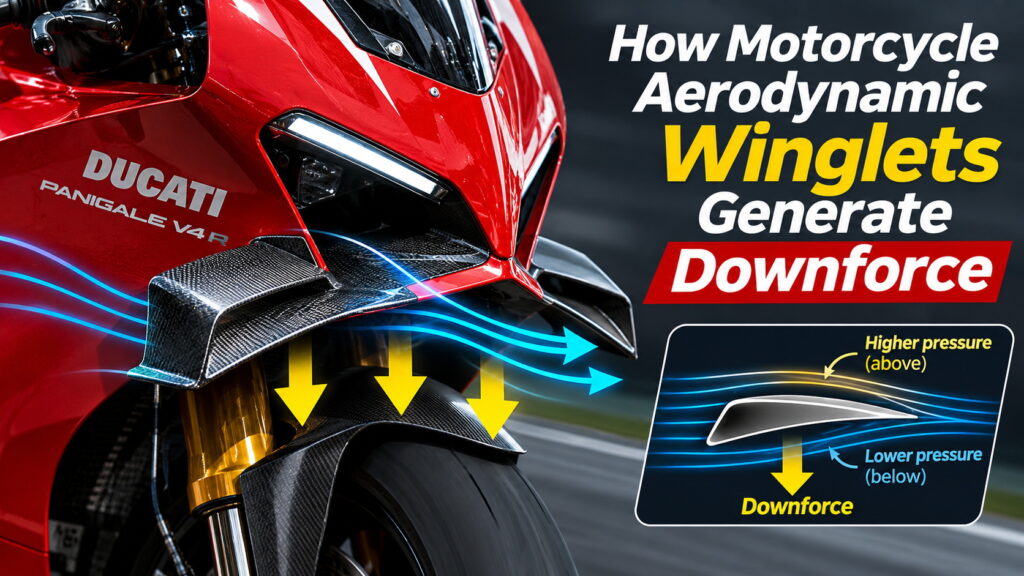
How Motorcycle Aerodynamic Winglets Generate Downforce
Modern superbikes are becoming increasingly sophisticated, and aerodynamic winglets are among their most recognizable engineering features. These small, wing-shaped structures help high-performance motorcycles maintain stability, reduce front-wheel lift, and improve control at high speeds.
Originally developed for racing applications, aerodynamic winglets are now commonly found on road-going superbikes such as the Ducati Panigale V4 and BMW M 1000 RR. But how do these components actually work?


1. What Are Motorcycle Aerodynamic Winglets?
Motorcycle winglets are aerodynamic surfaces mounted on a motorcycle’s fairing, generally around its front section. Their primary purpose is to generate downforce, an aerodynamic force that pushes the motorcycle toward the road.
Aircraft wings are generally designed to produce upward lift. Motorcycle winglets use aerodynamic principles in the opposite direction, helping increase the load applied to the tyres.
This becomes particularly valuable during high-speed acceleration, when powerful motorcycles naturally tend to lift their front wheels.
2. How Do Winglets Generate Downforce?
As a motorcycle moves forward, air flows around its bodywork and winglets. The winglet’s shape, angle, and orientation influence the direction and speed of this airflow.
In a typical downforce-generating configuration, aerodynamic pressure is relatively higher above the winglet and lower beneath it. This pressure difference creates a net downward force.
The winglet also changes the momentum of the surrounding air. By directing airflow upward, it experiences a corresponding downward reaction force.


The Downforce Equation
The magnitude of aerodynamic downforce can be approximated using:
Simplified aerodynamic downforce equation
Where:
- F: Downforce.
- ρ: Air density.
- v: Speed relative to the air.
- A: Reference aerodynamic area.
- C: Magnitude of the aerodynamic downforce coefficient.
The most important factor is speed. Because aerodynamic force increases approximately with the square of airspeed, doubling the speed can generate roughly four times the downforce under otherwise similar conditions.
3. How Winglets Improve Motorcycle Performance
Reducing Front-Wheel Lift
When a powerful motorcycle accelerates, weight transfer and acceleration forces can cause the front wheel to rise. Electronic anti-wheelie systems may intervene by reducing engine output.
Aerodynamic winglets produce additional downward force that helps counteract front-wheel lift. This can allow the motorcycle to accelerate more effectively without triggering as much electronic intervention.
Improving High-Speed Stability
Downforce contributes to the motorcycle’s aerodynamic balance and can increase the load on its front tyre. When properly integrated with the chassis and suspension, this helps maintain a more stable front end at high speeds.
Supporting Braking Performance
When a rider applies the brakes after a fast straight, the tyres must generate significant braking forces. Additional aerodynamic loading may help improve tyre contact and braking stability.
However, braking performance also depends on tyre compound, road conditions, suspension geometry, weight transfer, and electronic braking systems.
Improving Cornering Control
Modern winglets are developed to produce useful aerodynamic forces even while a motorcycle is leaned over.
This makes their design especially challenging. Unlike racing cars, motorcycles tilt significantly during cornering, changing the direction and distribution of aerodynamic forces.
4. How Much Downforce Can Motorcycle Winglets Produce?
BMW Motorrad published downforce figures for its 2023 M 1000 RR, demonstrating the relationship between motorcycle speed and aerodynamic loading.
| Speed | Reported Downforce |
|---|---|
| 150 km/h | 5.7 kgf |
| 200 km/h | 10.0 kgf |
| 250 km/h | 15.6 kgf |
| 300 km/h | 22.6 kgf |
Source: BMW Motorrad, 2023 M 1000 RR technical information. Figures express aerodynamic force as equivalent kilogram-force, rather than additional motorcycle mass.
At 300 km/h, the reported aerodynamic load corresponds to approximately 22.6 kilograms-force. The effect is substantial when compared with the much smaller forces generated at ordinary road speeds.
Modern MotoGP prototypes can generate even higher aerodynamic loads. MotoGP reports that winglets may create approximately 35–50 kgf of downforce at speeds around 350 km/h, depending on the motorcycle and configuration.
5. Ducati and BMW: Real-World Winglet Engineering
Ducati Panigale V4
Ducati has incorporated racing-inspired aerodynamic elements into its Panigale family. Winglets work together with the fairing to produce downforce, reduce wheelie tendency, and improve high-speed performance.
Ducati’s development illustrates how technology originally refined in MotoGP can influence the engineering of production superbikes.
BMW M 1000 RR


BMW has developed aerodynamic winglets using wind-tunnel testing and race-track evaluation. The M 1000 RR combines carbon-fibre winglets with carefully designed fairings to improve downforce while managing aerodynamic resistance.
For the 2023 model year, BMW reported a 39% increase in downforce compared with the preceding M 1000 RR design.
Later aerodynamic developments have continued to increase this performance, with BMW reporting approximately 30 kgf of downforce at 300 km/h for the updated M 1000 RR winglets introduced for the 2025 model year.
6. Why Engineers Must Balance Downforce and Drag
Although aerodynamic downforce offers important handling benefits, it does not come without compromises.
Winglets alter airflow and may increase aerodynamic drag, meaning the engine must produce additional power to overcome air resistance.
The engineering challenge is to generate the most useful downward force while minimizing unwanted drag, turbulence, additional weight, and handling disturbances.
Designers therefore consider:
- The winglet’s shape and aerodynamic angle.
- Its position relative to the motorcycle’s centre of gravity.
- Airflow around the rider and front fairing.
- Performance at different motorcycle lean angles.
- Structural strength, weight, and vibration resistance.
- The overall balance between downforce and aerodynamic drag.
7. Do Winglets Make a Difference in Everyday Riding?
At relatively low speeds, aerodynamic downforce is limited. For motorcycles used mainly in urban traffic or relaxed touring, winglets generally provide much smaller benefits than they do on a racetrack.
At higher speeds, particularly under hard acceleration and during track riding, their contribution can become considerably more significant.
This explains why large, sophisticated aerodynamic winglets are most frequently found on performance-focused superbikes rather than ordinary commuter motorcycles.
8. The Future of Motorcycle Aerodynamics
Motorcycle manufacturers continue to explore increasingly integrated aerodynamic solutions.
Future development is likely to emphasize more efficient fairing shapes, improved airflow control, aerodynamic stability during cornering, and better performance without excessive drag.
Motorsport regulations will also influence design choices. MotoGP’s 2027 technical regulations place tighter limits on aerodynamic bodywork, encouraging manufacturers to explore different solutions within the new restrictions.
Conclusion
Motorcycle aerodynamic winglets are much more than aggressive-looking styling elements. They are carefully engineered aerodynamic surfaces that convert airflow into downward force.
By reducing wheelie tendency, improving high-speed stability, and supporting tyre loading, winglets help modern superbikes exploit their performance more effectively.
As aerodynamic development continues, winglets and integrated fairing design will remain important technologies in high-performance motorcycle engineering.
References and Further Reading
- MotoGP — What Are Winglets and How Do They Work?
- BMW Motorrad — M 1000 RR Winglet Downforce
- BMW Group — Updated M 1000 RR Aerodynamics
Published by Bin3aiah Motors — Motorcycle Technology & Engineering.