


Views: 0
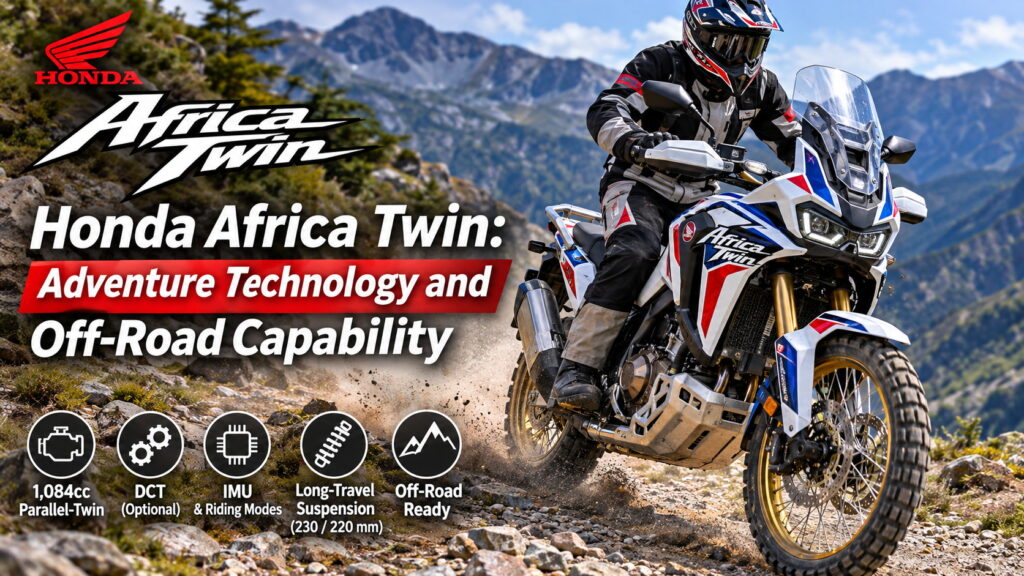
Honda Africa Twin: Adventure Technology and Off-Road Capability
The Honda Africa Twin is an adventure motorcycle built to travel far beyond paved roads. Combining rally-inspired design, a powerful parallel-twin engine, sophisticated electronics and long-travel suspension, the CRF1100L offers an impressive balance between long-distance touring and off-road exploration.


1. The Engineering Behind the Africa Twin
The Africa Twin’s engineering philosophy focuses on providing usable performance across different riding environments. Rather than emphasizing maximum horsepower alone, Honda has developed a motorcycle that delivers predictable power, balanced handling and a riding position suitable for both seated touring and standing off-road control.
The CRF1100L is powered by a 1,084cc liquid-cooled parallel-twin engine featuring a 270-degree crankshaft and Honda’s Unicam valve train. The engine’s configuration provides strong low- and midrange torque, helping riders accelerate smoothly over loose gravel, rocky trails and steep inclines.
In 2026 UK specifications, the engine produces 75 kW (approximately 101 hp) at 7,500 rpm and 112 Nm at 5,500 rpm. Performance figures may differ by market.
2. Advanced Riding Electronics
One of the Africa Twin’s most significant technological features is its six-axis Inertial Measurement Unit (IMU). The system monitors motorcycle movement and orientation, providing information to several electronic rider-assistance systems.
- Honda Selectable Torque Control: Helps manage rear-wheel slip by controlling engine torque.
- Cornering ABS: Uses motion information to adapt braking intervention during cornering.
- Wheelie Control: Helps control front-wheel lift during acceleration.
- Selectable Riding Modes: Tour, Urban, Gravel, Off-Road and customizable User settings.
- Rear ABS Control: Allows the rider to disable rear-wheel ABS in designated off-road settings.
These technologies expand the motorcycle’s adaptability without removing the need for rider judgment, especially on sand, mud and loose gravel.

3. Dual-Clutch Transmission Technology
Honda’s optional Dual-Clutch Transmission (DCT) is among the Africa Twin’s most distinctive engineering features.
The six-speed DCT uses two clutches to control alternating gear sets, enabling automatic gear changes without a conventional clutch lever. Riders can select automatic operation or request gear changes manually using handlebar switches.
For adventure riding, DCT can reduce the workload associated with clutch operation, particularly during slow-speed maneuvering, long journeys and changing terrain.
However, some experienced off-road riders prefer the conventional manual gearbox because it provides direct clutch control when negotiating obstacles, managing traction or performing precise technical maneuvers.
4. Suspension and Off-Road Geometry
The standard Africa Twin features a 21-inch front wheel and an 18-inch rear wheel, an arrangement commonly associated with serious off-road motorcycles.
The larger front wheel improves the ability to roll over obstacles, while the long-travel suspension absorbs impacts from rough surfaces.
For the 2026 standard Africa Twin, Honda specifies approximately 230 mm of front suspension travel and 220 mm at the rear. The motorcycle uses a 45 mm inverted Showa front fork and a Pro-Link rear suspension arrangement.
Its substantial ground clearance and upright rider ergonomics are particularly valuable when crossing uneven trails or riding while standing on the footpegs.


5. Honda Africa Twin Technical Specifications
The following specifications refer primarily to the 2026 UK-market standard CRF1100L with manual transmission.
| Specification | Details |
|---|---|
| Engine | 1,084cc parallel twin |
| Cooling | Liquid-cooled |
| Maximum Power | 75 kW (approximately 101 hp) |
| Maximum Torque | 112 Nm |
| Transmission | Six-speed manual; DCT available |
| Front Wheel | 21 inches |
| Rear Wheel | 18 inches |
| Front Suspension Travel | 230 mm |
| Rear Suspension Travel | 220 mm |
| Fuel Capacity | 18.8 liters |
| Seat Height | 850/870 mm |
| Kerb Weight | 233 kg |
6. Africa Twin vs. Adventure Sports
Honda offers different interpretations of the Africa Twin platform to accommodate varying riding priorities.
Standard Africa Twin: Focuses more strongly on off-road riding, with its 21-inch front wheel, long-travel suspension and greater emphasis on rough-terrain capability.
Africa Twin Adventure Sports: Emphasizes longer-distance touring, incorporating a larger fuel tank, a 19-inch front wheel on recent versions, and suspension and equipment choices oriented toward comfortable road travel.


7. How Capable Is the Africa Twin Off-Road?
The Africa Twin is designed for mixed-terrain adventure rather than exclusively paved-road touring. Its strong engine torque, large front wheel, suspension travel and standing-rider ergonomics allow it to tackle gravel tracks, rocky paths and many desert routes.
Nevertheless, the Africa Twin is considerably heavier than a dedicated enduro motorcycle. Technical climbs, deep sand and slow-speed obstacle sections demand experience and careful motorcycle control.
Tire selection is also important. Adventure-oriented road tires may perform adequately on maintained gravel, but challenging sand and mud often require more specialized off-road tires.
8. Touring Technology and Everyday Practicality
The Africa Twin combines rugged mechanical engineering with modern touring equipment. Depending on market and version, features include cruise control, a 6.5-inch TFT display, smartphone integration, USB connectivity and electronically adjustable suspension.
Its upright riding position and broad adventure-touring capability make it suitable for riders who regularly transition between highways, mountain roads and unpaved tracks.
Conclusion: An Adventure Motorcycle Built for Exploration
The Honda Africa Twin demonstrates how modern motorcycle engineering can combine genuine off-road capability with long-distance usability.
Its 1,084cc parallel-twin engine, advanced rider assistance, optional DCT and off-road-focused chassis make it one of Honda’s most versatile adventure motorcycle platforms.
For riders seeking an adaptable motorcycle capable of handling both highways and demanding trails, the Africa Twin remains a compelling choice.
Technical References
- Honda UK – CRF1100L Technical Specifications
- Honda Powersports – Africa Twin
- Honda UAE – Africa Twin
Photography Credits and Licenses
Motorcycle photographs by Chanokchon and Mr.choppers, via Wikimedia Commons. All four images are licensed under Creative Commons Attribution-ShareAlike 4.0. No photographic alterations are indicated in this article.
Individual image source pages: 2026 Africa Twin | 2025 Africa Twin | 2020 Africa Twin | 2022 Adventure Sports.


