


Views: 1
BIN3AIAH MOTORS | MOTORCYCLE LEGENDS
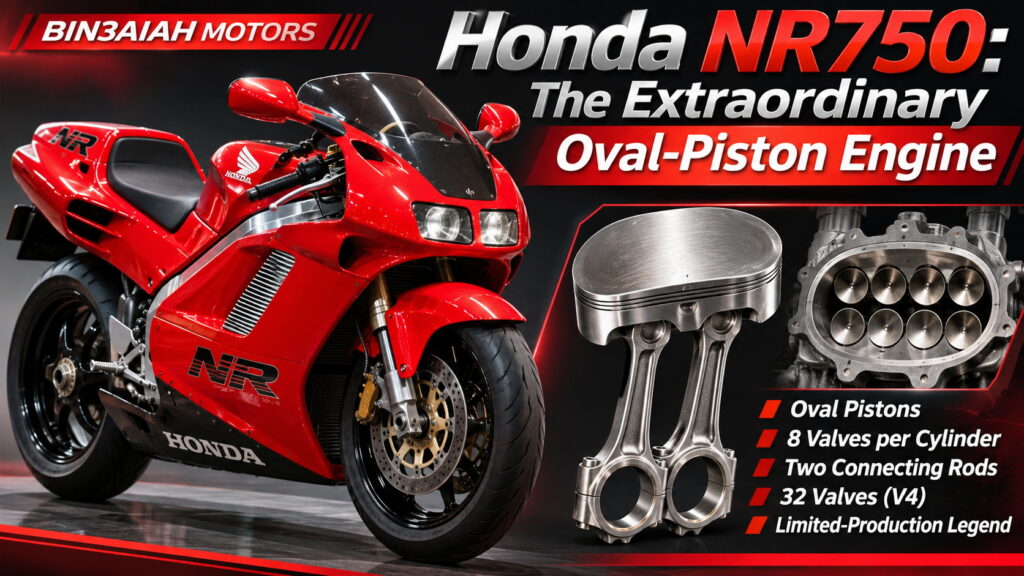
Honda NR750: The Extraordinary Oval-Piston Engine
1992 | Honda | RC40 | Japanese Engineering


The Honda NR750 is one of the most unusual and ambitious motorcycles in automotive history. Introduced in 1992 under the official model name Honda NR and chassis designation RC40, this extraordinary superbike brought Honda’s experimental oval-piston engine technology to the road.
Rather than following conventional motorcycle engineering, Honda developed an engine with four elongated pistons, eight valves per cylinder and two connecting rods for each piston. The result was a remarkable machine that demonstrated what could be achieved when engineers challenged established mechanical principles.
Honda NR750 at a Glance
Launch Year
Displacement
Approx. Power
Engine Valves
Connecting Rods
Configuration
1. The Origins of Honda’s Oval-Piston Engine
The NR750’s story began during the late 1970s when Honda returned to Grand Prix motorcycle racing with an ambitious four-stroke engine project.
At the time, two-stroke engines dominated the 500 cc racing category. Honda wanted to compete using four-stroke technology while remaining within regulations that limited engines to four cylinders.
Honda’s solution was to develop elongated pistons that could accommodate more valves than conventional circular pistons. This concept appeared in the experimental NR500 racing motorcycle in 1979.


Although the early racing program faced significant reliability and performance challenges, Honda continued refining the technology. More than a decade of experimentation eventually contributed to the development of the road-going NR.
2. How the Oval-Piston Engine Works
Traditional combustion engines use circular pistons that move vertically within matching cylindrical bores. The Honda NR engine instead uses elongated pistons with a specially developed curved profile.
The wider combustion chamber creates additional space for intake and exhaust valves, allowing Honda to install eight valves in each cylinder.


Key engineering features
- Four elongated pistons.
- Four intake valves per cylinder.
- Four exhaust valves per cylinder.
- Two connecting rods per piston.
- Two spark plugs per cylinder.
- 32 valves across four cylinders.
- Gear-driven double overhead camshafts.
- Electronic fuel injection.
- Liquid cooling.
The concept resembles combining the breathing characteristics of two smaller cylinders into one elongated combustion chamber. Although the engine is sometimes compared to a V8, it remains mechanically a four-cylinder engine.
3. Oval Pistons vs Conventional Pistons
| Feature | Typical 4-Valve V4 | Honda NR750 |
|---|---|---|
| Piston Shape | Circular | Elongated oval |
| Valves per Cylinder | 4 | 8 |
| Total Valves | 16 | 32 |
| Connecting Rods | 4 | 8 |
| Manufacturing | Conventional | Highly specialized |
| Piston Ring Design | Circular | Complex non-circular profile |
4. Why Honda Chose Eight Valves per Cylinder
Engine performance depends partly on how efficiently air enters and exhaust gases leave the combustion chamber.
Using multiple smaller valves can increase available flow area while limiting individual valve mass. These characteristics are particularly useful in engines designed to operate at high rotational speeds.
Honda pursued this arrangement to improve breathing capacity without increasing the cylinder count. However, the additional components introduced substantial mechanical complexity and manufacturing challenges.
5. Honda NR750 Technical Specifications
| Specification | Details |
|---|---|
| Manufacturer | Honda Motor Co. |
| Model | Honda NR (RC40) |
| Launch Year | 1992 |
| Country | Japan |
| Engine | 90-degree four-stroke V4 |
| Displacement | 747.7 cc |
| Valve Train | DOHC, 32 valves |
| Maximum Power | Approximately 125 hp at 14,000 rpm |
| Compression Ratio | 11.7:1 |
| Fuel System | Electronic fuel injection |
| Transmission | 6-speed manual |
| Cooling | Liquid-cooled |
| Frame | Aluminium twin-spar |
| Swingarm | Single-sided |
| Production | Limited production |
Published power figures vary according to market specification, measurement convention and historical source.
6. Revolutionary Motorcycle Design


The NR750’s appearance was almost as remarkable as its engine. Its streamlined red bodywork and premium construction established a futuristic visual identity.
Notable design features
- Carbon-fibre bodywork components.
- Distinctive twin headlights.
- Under-seat exhaust outlets.
- Single-sided rear swingarm.
- Aluminium chassis construction.
- Inverted front suspension.
- Racing-inspired aerodynamic styling.
Many of these features became increasingly familiar on high-performance motorcycles during the following decades.
7. Advantages and Disadvantages
Engineering Advantages
- Increased potential valve flow area.
- High-revving engine architecture.
- Unconventional combustion chamber design.
- Advanced racing-derived technology.
- Exceptional engineering originality.
Engineering Challenges
- Expensive manufacturing processes.
- Complex piston ring sealing.
- Additional mechanical components.
- Specialized servicing requirements.
- Limited practical advantage over simpler engines.
8. Why Oval-Piston Engines Never Became Mainstream
The NR750 demonstrated that an oval-piston engine could function successfully in a production motorcycle. However, demonstrating technical feasibility does not necessarily establish commercial viability.
Conventional circular pistons are easier to manufacture, seal and maintain. Improvements in materials, cylinder-head design, fuel injection and valve technology also allowed traditional engines to achieve impressive performance without adopting Honda’s complicated architecture.
The NR therefore remained an exceptional engineering experiment rather than the beginning of widespread oval-piston motorcycle production.
9. Honda NR Development Timeline
1979 – Honda NR500
Honda introduces its experimental oval-piston Grand Prix racing motorcycle.
1981 – Racing Progress
The NR program achieves a significant victory at the Suzuka 500-kilometre race.
1987 – NR750 Racing Development
A larger-displacement oval-piston engine continues Honda’s endurance racing experiments.
1992 – Honda NR RC40
Honda brings its oval-piston technology to customers through a limited-production road motorcycle.
Today – Engineering Icon
The NR remains celebrated for its rarity, innovative engine and distinctive design.
10. Honda NR Photo Gallery


Gallery photographs are displayed without intentional alterations. Individual source pages contain original credits and licensing information.
11. Frequently Asked Questions
What makes the Honda NR750 special?
Its oval-piston V4 engine features eight valves and two connecting rods per cylinder, making it one of the most unconventional production motorcycle engines ever developed.
Is the Honda NR750 a V8?
No. It has four cylinders and four pistons. Its valve arrangement shares certain conceptual characteristics with an eight-cylinder engine.
How powerful is the Honda NR750?
International road versions are commonly reported to produce approximately 125 horsepower at 14,000 rpm.
Is the Honda NR750 still manufactured?
No. The original Honda NR was a limited-production model introduced in 1992 and is now considered a collectible motorcycle.
Why are oval-piston engines so rare?
Their specialized manufacturing requirements, sealing difficulties and mechanical complexity make them considerably more challenging to produce than conventional engines.
Conclusion
The Honda NR750 represents a remarkable chapter in motorcycle engineering. It combined innovative mechanical architecture, exotic materials and experimental racing technology in a road-legal motorcycle unlike almost anything else available at the time.
Its greatest achievement was not simply horsepower or speed, but its demonstration of Honda’s willingness to explore unconventional solutions. Decades after its introduction, the NR remains a powerful symbol of engineering imagination and Japanese motorcycle innovation.