


Views: 0
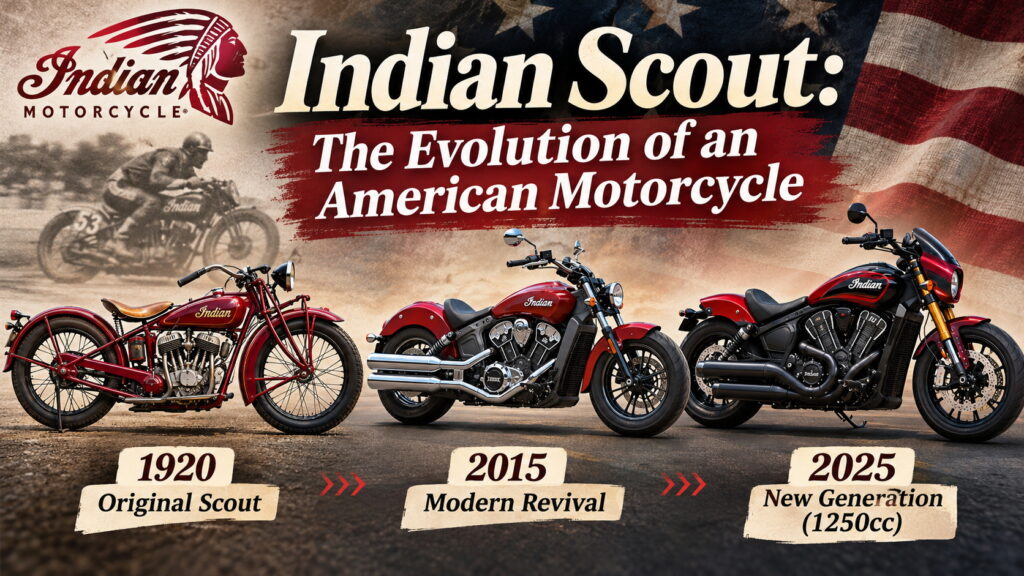
Indian Scout: The Evolution of an American Motorcycle
The Indian Scout is one of the most recognizable motorcycles in American history. Since its introduction in 1920, the Scout has earned a reputation for its distinctive V-twin engine, agile handling, racing heritage, and timeless cruiser styling.
From the legendary motorcycles of the 1920s to the modern 1250cc Scout generation, the story of this American icon reflects more than a century of motorcycle innovation.


1920: The Birth of the Indian Scout
Indian Motorcycle introduced the original Scout in 1920. Designed as a relatively lightweight and maneuverable motorcycle, it offered an alternative to the company’s larger machines.
The first Scout featured a 37-cubic-inch (approximately 606cc) side-valve V-twin engine. Its balance of performance, durability, and practical engineering helped it attract everyday riders and motorcycle enthusiasts.
The Scout soon developed a reputation as a capable motorcycle that could perform well on ordinary roads and in sporting competition.
1928: The Legendary Indian 101 Scout


One of the most celebrated motorcycles in the Scout family arrived in 1928: the Indian 101 Scout.
Its redesigned chassis, favorable weight distribution, low seating position, and improved handling made it particularly popular with riders who appreciated sporty motorcycles.
The 101 Scout was offered with different engine capacities, including the larger 45-cubic-inch (approximately 737cc) V-twin. It became one of Indian’s most respected early models.
Produced through 1931, the 101 Scout remains highly regarded by vintage motorcycle collectors.
Racing Success and the Scout’s Reputation


The Indian Scout was more than a comfortable road motorcycle. Early Scouts built a reputation in motorcycle racing, including board-track and dirt-track competition.
The Scout’s compact dimensions and V-twin performance made it suitable for competitive riding. Its popularity also extended to police and other professional applications.
One especially famous chapter of Scout history involved New Zealand speed enthusiast Burt Munro, who spent decades modifying a 1920 Indian Scout for land-speed racing. In 1967, he established a record in the under-1000cc streamliner class at Bonneville, achieving a two-way average of approximately 183.6 mph.
Munro’s extraordinary project later inspired the film The World’s Fastest Indian.
1930s–1953: Evolution and the End of an Era
Following the success of the 101 Scout, Indian continued developing the Scout name through various models, including the Sport Scout.
These machines introduced changes to frames, suspension systems, engines, and equipment while maintaining the distinctive American V-twin character.
However, financial difficulties eventually affected Indian Motorcycle. The original Springfield manufacturing operation ended in 1953, bringing an important chapter of the Scout story to a close.
2014: The Indian Scout Returns


After decades without regular production, the Indian Scout returned under Polaris ownership. Unveiled in 2014 for the 2015 model year, the revived motorcycle combined classic styling with modern technology.
Its most important engineering change was the introduction of a liquid-cooled 1,133cc V-twin engine with electronic fuel injection and a six-speed transmission.
The new Scout preserved the low stance and recognizable American cruiser proportions of its predecessors while offering a contemporary chassis, brakes, and suspension.
It played an important role in introducing the historic Indian brand to a new generation of motorcycle riders.
2025: A New Scout Generation
In April 2024, Indian Motorcycle revealed an extensively redesigned Scout family for the 2025 model year.
At the center of the redesign was the SpeedPlus 1250, a liquid-cooled V-twin engine with a displacement of 1,250cc. The redesigned motorcycles also received a new steel tubular frame and updated electronic equipment.
The original next-generation family consisted of five distinctive models:
- Scout Bobber: Minimalist cruiser styling with chopped fenders and an aggressive riding position.
- Scout Classic: Traditional cruiser styling with chrome details and classic fenders.
- Sport Scout: Sport-inspired styling, a quarter fairing, and a 19-inch front wheel.
- Super Scout: Touring-oriented equipment including saddlebags, a windshield, and passenger accommodations.
- 101 Scout: A performance-focused tribute to the historic 101, featuring upgraded components and greater engine output.
Explore the manufacturer photographs of the new generation in the official Indian Motorcycle 2025 Scout gallery.
Indian Scout Engineering: Classic and Modern
The most significant transformation in the Scout’s history has been the progression from early side-valve engines and simple frames to liquid-cooled, electronically managed modern motorcycles.
| Specification | 1920 Scout | 2015 Scout | 2025 Scout |
|---|---|---|---|
| Engine | Side-valve V-twin | Liquid-cooled V-twin | Liquid-cooled V-twin |
| Displacement | Approx. 606cc | 1,133cc | 1,250cc |
| Fuel system | Carburetor | Electronic fuel injection | Electronic fuel injection |
| Cooling | Air-cooled | Liquid-cooled | Liquid-cooled |
| Transmission | 3-speed | 6-speed | 6-speed |
Specifications are representative of the stated models and generations. Individual variants and market configurations may differ.
Why the Indian Scout Remains Important
Few American motorcycle names have connected the early days of motorcycling with modern engineering as effectively as the Indian Scout.
Its appeal comes from a combination of history, design, accessible proportions, and V-twin performance. The motorcycle has evolved from a practical early machine into a family of modern cruisers while maintaining much of its recognizable character.
The Scout also demonstrates how engineering innovations can transform a motorcycle without completely abandoning its traditional identity.
Conclusion
From the original 1920 model and the celebrated 101 Scout to the revived 2015 motorcycle and the new 1,250cc generation, the Indian Scout has undergone a remarkable transformation.
Its story is a celebration of American motorcycle design, competition, innovation, and the lasting appeal of the V-twin cruiser.
More than a century after its introduction, the Indian Scout continues to connect today’s riders with one of the most recognizable names in motorcycle history.
Sources and Image Credits
- Indian Motorcycle – 2025 Scout introduction
- 1920 Indian Scout – public-domain photograph
- 1928 Indian 101 Scout – TaurusEmerald, CC BY-SA 4.0
- Historic Indian Scouts – National Park Service, public domain
- Modern Indian Scout – Kawijock, CC BY-SA 4.0
Creative Commons photographs are reproduced with attribution. Their respective license conditions apply, including share-alike requirements where applicable. No photographs have been altered for this article.