


Views: 0
Kawasaki Ninja H2R: The Supercharged Track Machine
BIN3AIAH MOTORS | Motorcycle Engineering & Performance | 2026


7
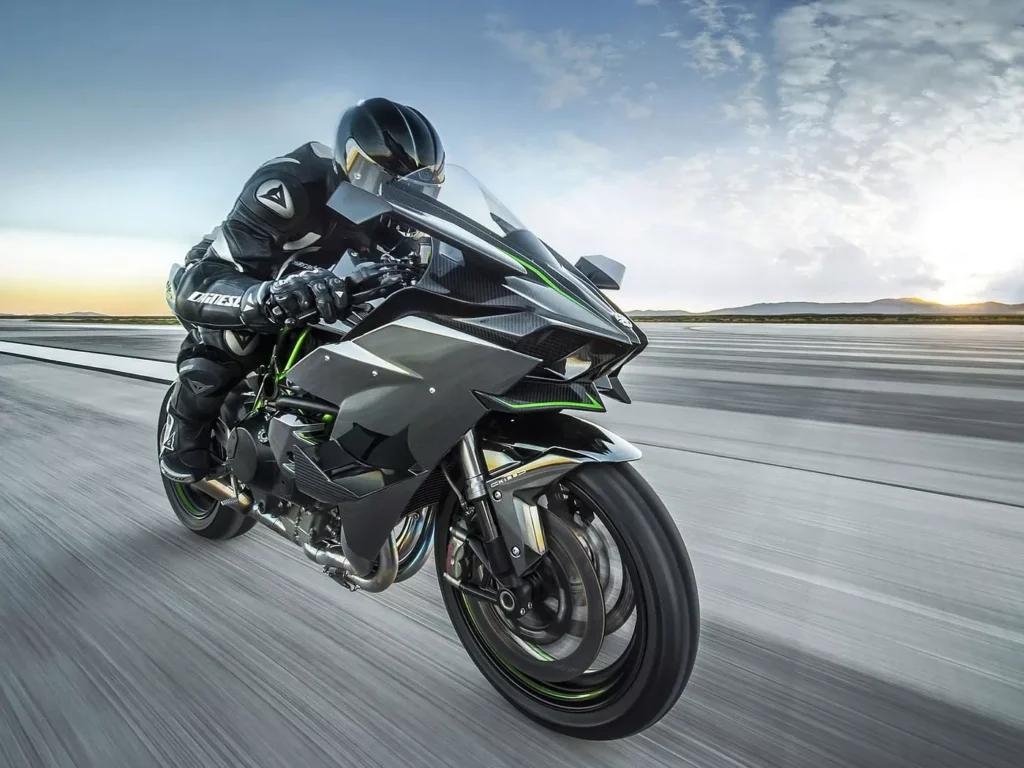
The Kawasaki Ninja H2R is one of the most extraordinary motorcycles ever produced. With its supercharged 998cc inline-four engine, aggressive carbon-fiber aerodynamic wings, and uncompromising track-only design, it represents Kawasaki’s pursuit of extreme motorcycle performance.
Unlike conventional superbikes designed around racing-class restrictions or road regulations, the Ninja H2R was engineered to explore what happens when extraordinary power meets advanced aerodynamics and sophisticated chassis technology.
Its headline figure is astonishing: 310 PS, increasing to 326 PS with ram-air assistance, according to Kawasaki’s 2026 specifications.
Kawasaki
+1
Kawasaki Ninja H2R — Technical Specifications
Engine
998 cc
Supercharged inline-four
Maximum power
326 PS
With ram-air assistance
Maximum torque
165 Nm
At 12,500 rpm
Wet weight
216 kg
2025 European specification
| Specification | Details |
|---|---|
| Manufacturer | Kawasaki |
| Introduced | 2014, as a 2015 model |
| Engine | Liquid-cooled, DOHC, 16-valve inline-four |
| Forced induction | Kawasaki centrifugal supercharger |
| Power | 228 kW / 310 PS at 14,000 rpm |
| Power with ram air | 240 kW / 326 PS at 14,000 rpm |
| Transmission | 6-speed, dog-ring design |
| Frame | High-tensile steel trellis |
| Rear suspension | Öhlins TTX36 |
| Front brakes | Dual 330 mm discs, Brembo calipers |
| Fuel capacity | 17 litres |
| Road legality | Closed-course use only |
Specifications based on Kawasaki’s official 2025–2026 publications; equipment can vary by model year and market.
Kawasaki
+2
1. The Supercharged Engine: Engineering Without Compromise


At the heart of the H2R is a 998cc engine with a centrifugal supercharger developed by Kawasaki itself.
A conventional naturally aspirated engine depends on atmospheric pressure to fill its cylinders. A supercharger compresses the incoming air, allowing more oxygen into the combustion chambers. With additional fuel, the engine can generate substantially more power.
Kawasaki developed the H2R’s supercharger using engineering expertise from across its industrial divisions. The original system used planetary gears and could spin its impeller at approximately 130,000 rpm, enabling an unusually powerful yet compact forced-induction system.
2015 Kawasaki Ninja H2R[2].docx
+1
This engine’s defining characteristic is not merely its peak power, but its intense acceleration and the distinctive mechanical sound of the supercharger.
2. Aerodynamics Inspired by Aerospace Engineering


8
The H2R’s carbon-fiber wings are functional components, not just styling elements.
Developed with input from Kawasaki’s aerospace engineers, the wings help generate downforce and counteract lift as speed increases. This supports high-speed stability and gives the H2R its immediately recognizable appearance.
The machine combines a compact frontal profile, carefully sculpted bodywork, and a single-rider layout designed around high-speed performance.
Kawasaki Heavy Industries
+1
3. Chassis, Suspension and Braking
The H2R uses a distinctive green high-tensile steel trellis frame, engineered to achieve a balance between structural rigidity and controlled flexibility.
Rather than maximizing stiffness at any cost, Kawasaki designed the chassis to remain stable under extreme acceleration and at very high speeds. Its open-frame layout also supports heat dissipation.
The single-sided swingarm adds to the motorcycle’s distinctive appearance, while the adjustable suspension and premium braking hardware are intended to manage the demands of its extraordinary performance.
Modern H2R specifications include an Öhlins TTX36 rear shock and Brembo Stylema front calipers.
2015 Kawasaki Ninja H2_v5.docx
+1
4. Electronics Designed to Control Extreme Power
Even experienced riders need electronic assistance when managing the H2R’s acceleration.
Depending on its model year, the Ninja H2R includes Kawasaki traction control, launch control, engine-braking management, intelligent ABS and a quick-shifter system.
The newer machines use a Bosch inertial measurement unit alongside Kawasaki’s electronic control strategy to help the bike respond to changing riding conditions. These systems support control, but cannot override the limits of tire grip or rider skill.
Closed-Course Hypersport Motorcycle
5. Why the H2R Is Not Road Legal
Unlike the street-oriented Ninja H2, the H2R is designed specifically for closed-course use.
Its configuration, performance focus, aerodynamic bodywork and track equipment reflect its purpose as an extreme-performance machine rather than an everyday motorcycle.
It is also important to distinguish a track-only motorcycle from a motorcycle homologated for professional racing. The H2R was not developed to comply with a conventional superbike racing class; it was designed to pursue performance outside those restrictions.
Kawasaki Heavy Industries
+1
6. The H2R’s Place in Motorcycle History
Kawasaki first revealed the Ninja H2R at INTERMOT in Cologne on September 30, 2014, ahead of its 2015 model-year introduction.
Its significance extends beyond raw horsepower. The project united Kawasaki’s motorcycle development, turbine engineering and aerospace expertise to create a machine that showcased what the wider Kawasaki group could achieve.
The result became a modern icon of supercharged motorcycle engineering and helped establish the Ninja H2 family as a particularly recognizable name in high-performance motorcycling.
Kawasaki Heavy Industries, Ltd.
+1
Final Verdict
The Kawasaki Ninja H2R is not designed to be practical, comfortable or accessible to every rider. Its purpose is to demonstrate extreme performance through advanced mechanical engineering.
From its extraordinary supercharged engine to its aerospace-inspired aerodynamic wings, the H2R remains a compelling example of what manufacturers can build when the usual restrictions are removed.
The Ninja H2R is more than a superbike. It is a rolling demonstration of Kawasaki’s engineering ambition.
Bonus: The Famous 400 km/h Run
In June 2016, professional motorcycle racer Kenan Sofuoğlu reached an indicated 400 km/h (approximately 249 mph) on a Ninja H2R during a specially organized run on Turkey’s Osman Gazi Bridge.
The achievement demonstrated the motorcycle’s extraordinary speed potential, although it should not be confused with a standardized, independently verified two-way production-motorcycle speed record.

The Official Home of WorldSBK
+1
Videos


Official Kawasaki Promotional Video
2015 Ninja H2R — Kawasaki


Built Beyond Belief
Official Kawasaki video


The 400 km/h Speed Attempt
Kenan Sofuoğlu, 2016
WordPress SEO Package
| Field | Recommended content |
|---|---|
| Website | motors.bin3aiah.net |
| Post title | Kawasaki Ninja H2R: The Supercharged Track Machine |
| Slug | kawasaki-ninja-h2r-supercharged-track-machine |
| Focus keyword | Kawasaki Ninja H2R |
| Secondary keywords | Ninja H2R specs, Kawasaki supercharger, H2R top speed |
| Category | Kawasaki / Superbikes |
| Meta description | Explore the Kawasaki Ninja H2R, its 998cc supercharged engine, 326 PS output, advanced aerodynamics, track performance and incredible history. |
Suggested featured image: Official Kawasaki Ninja H2R front three-quarter photograph, showing the green trellis frame and carbon-fiber winglets. Use an authorized Kawasaki press image or another suitably licensed photograph; online visibility alone does not grant republication rights.
Primary official references: 2026 Kawasaki Specifications and Kawasaki’s original 2014 announcement.
This article and SEO package are prepared for Bin3aiah Motors. Publication has not been performed, and the suggested images still require rights verification before uploading.