


Views: 0
Royal Enfield Himalayan 450: Adventure Motorcycle Design
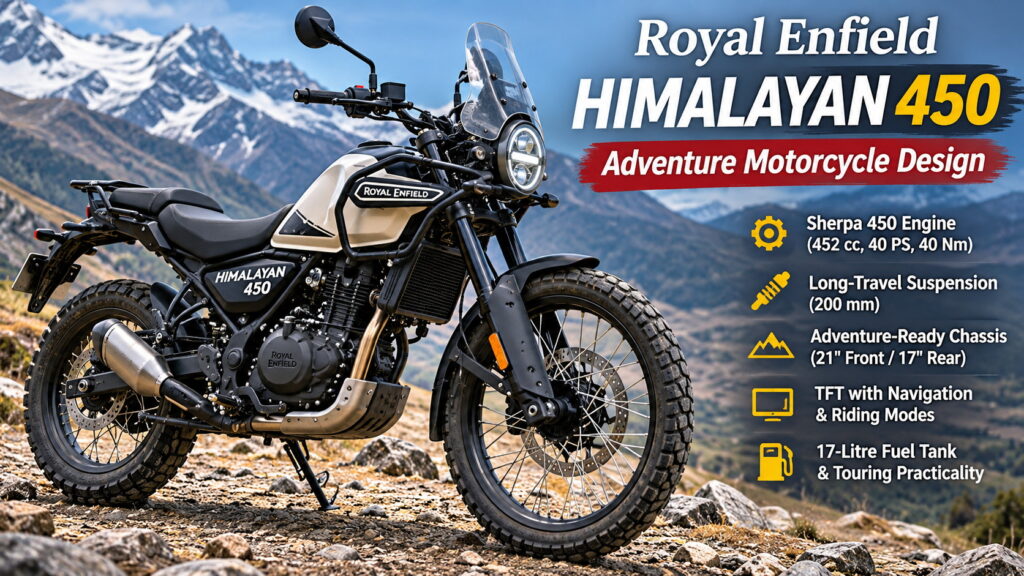
The Royal Enfield Himalayan 450 represents a major step forward in adventure motorcycle engineering. Built for mountain roads, challenging trails, and long-distance touring, it combines rugged styling with a modern engine, advanced suspension, and practical rider technology.
Introduced in 2023, the new Himalayan builds on the character of the original Himalayan 411 while offering a redesigned chassis, greater engine performance, and improved versatility.


Adventure-Focused Motorcycle Design
The Himalayan 450 follows a functional design philosophy. Instead of excessive bodywork, Royal Enfield emphasizes practical features that support both daily riding and demanding travel.
Its round LED headlight preserves the model’s recognizable identity, while the tall windscreen helps reduce wind exposure during highway journeys. Wide handlebars provide leverage and control, particularly when riding over uneven terrain.
The narrow seat-and-tank junction allows easier body movement during off-road riding. Protective tubular structures, luggage mounting provisions, and an upright seating position further reinforce the motorcycle’s adventure-oriented character.
The Sherpa 450 Engine
One of the motorcycle’s most significant developments is its Sherpa 450 engine, a 452 cc liquid-cooled, single-cylinder, four-valve DOHC unit.
Producing approximately 40.02 PS at 8,000 rpm and 40 Nm at 5,500 rpm, the engine delivers considerably more performance than the previous Himalayan 411.
Its electronic fuel injection and ride-by-wire throttle provide controlled power delivery. A six-speed gearbox improves flexibility across varying speeds, while the slip-and-assist clutch makes gear changes easier and helps manage rear-wheel behavior during aggressive downshifting.
Liquid cooling improves temperature management during extended riding, particularly in hot conditions or when climbing challenging routes.
Chassis and Suspension Engineering
The Himalayan 450 features a steel twin-spar tubular frame engineered for stable handling and practical off-road capability.
At the front, a 43 mm upside-down fork provides 200 mm of suspension travel. The rear uses a linkage-type monoshock, also offering 200 mm of travel.
This configuration helps the motorcycle absorb bumps, rocky surfaces, and irregular terrain while maintaining a comfortable riding experience on paved roads.
The 21-inch front wheel is particularly important for adventure performance. Its larger diameter helps the motorcycle roll over obstacles, while the 17-inch rear wheel contributes to traction and stability.


Royal Enfield Himalayan 450 Specifications
| Specification | Details |
|---|---|
| Engine | 452 cc single-cylinder DOHC |
| Cooling | Liquid-cooled |
| Maximum Power | 40.02 PS at 8,000 rpm |
| Maximum Torque | 40 Nm at 5,500 rpm |
| Transmission | 6-speed manual |
| Frame | Steel twin-spar tubular |
| Front Suspension | 43 mm USD fork |
| Suspension Travel | 200 mm front and rear |
| Wheels | 21-inch front / 17-inch rear |
| Ground Clearance | 230 mm |
| Standard Seat Height | 825–845 mm adjustable |
| Fuel Tank | 17 litres |
| Kerb Weight | 196 kg (manufacturer definition) |
| Braking | Front and rear discs with switchable dual-channel ABS |
Specifications may vary by market, variant, and model year.
Modern Technology and Rider Features
Despite its classic adventure motorcycle appearance, the Himalayan 450 incorporates modern electronics that improve navigation, convenience, and everyday operation.
Its four-inch circular TFT instrument cluster supports smartphone connectivity and Google Maps-powered navigation. This allows riders to follow routes using the motorcycle’s integrated display.
Additional features include riding modes, USB-C charging, LED lighting, and switchable ABS. The ride-by-wire throttle also allows electronic adjustment of throttle response according to the selected riding mode.
Off-Road Capability
The Himalayan 450 is engineered for riders who frequently encounter gravel roads, rocky tracks, and uneven surfaces.
Its combination of generous ground clearance, long-travel suspension, and a large front wheel helps it negotiate obstacles that would challenge conventional road motorcycles.
Wide handlebars and substantial footpegs support standing control when navigating difficult surfaces. The motorcycle’s relatively narrow central section also assists body positioning during off-road riding.
However, its approximately 196 kg kerb weight means that controlling the motorcycle on steep or loose terrain still requires experience and appropriate technique.
Long-Distance Touring Comfort
Touring practicality is another important element of the Himalayan 450’s design.
The upright seating position helps reduce fatigue during extended journeys, while the windscreen provides some protection from airflow at highway speeds.
The 17-litre fuel tank supports longer journeys between fuel stops, although actual range depends on terrain, speed, riding conditions, and fuel consumption.
Available luggage accessories expand its ability to carry travel equipment, making it suitable for weekend exploration and extended adventure trips.
Himalayan 450 vs Himalayan 411
The original Himalayan 411 was known for simple mechanical engineering, relaxed performance, and approachable adventure riding.
The Himalayan 450 introduces major improvements, including substantially greater engine output, liquid cooling, a six-speed gearbox, redesigned suspension, and more sophisticated electronics.
These changes make the newer motorcycle more capable for mixed highway and off-road travel. The trade-off is increased mechanical complexity compared with its simpler predecessor.
Who Is the Himalayan 450 Designed For?
The Royal Enfield Himalayan 450 is particularly appealing to riders looking for a practical adventure motorcycle that can manage everyday commuting, highway touring, and recreational off-road exploration.
Its manageable power delivery, versatile riding position, and balanced chassis make it attractive to a broad range of riders. Nevertheless, beginners should consider the motorcycle’s seat height and weight before tackling demanding terrain.
Conclusion
The Royal Enfield Himalayan 450 illustrates how modern motorcycle engineering can enhance a traditional adventure concept without losing its original character.
With the Sherpa 450 engine, long-travel suspension, advanced TFT display, and versatile chassis design, the motorcycle provides an appealing combination of performance, ruggedness, and touring practicality.
For riders who value exploration and versatility more than extreme speed, the Himalayan 450 represents a compelling adventure motorcycle.