


Views: 8
BIN3AIAH MOTORS | BRITISH SUPERSPORT
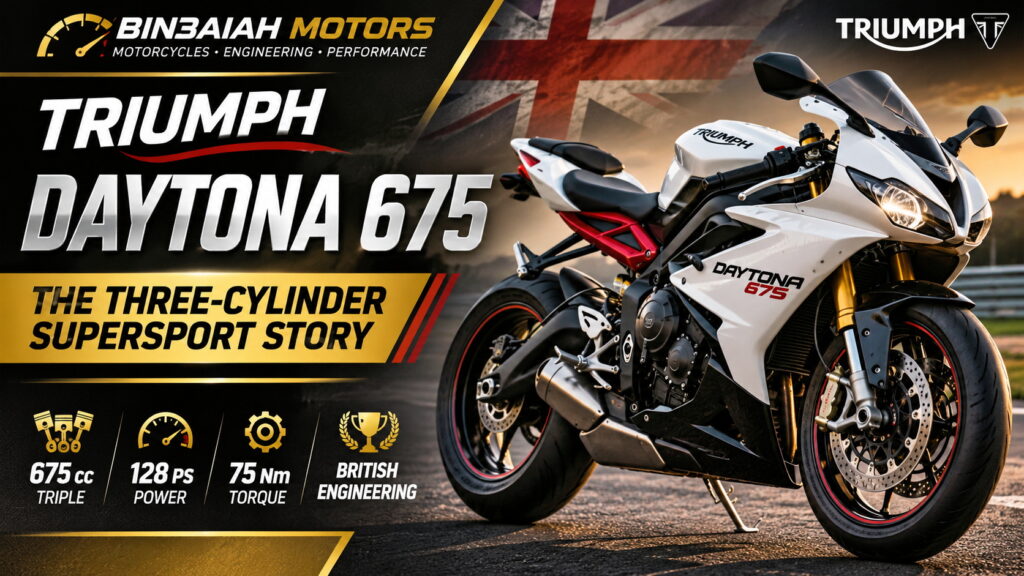
Triumph Daytona 675: The Three-Cylinder Supersport Story
Three cylinders. Exceptional agility. British engineering. Discover the motorcycle that challenged the traditional supersport formula.


Displacement
Maximum Power
Peak Torque
Cylinders
Performance figures refer to the 2013 Daytona 675.
Introduction: Challenging Supersport Convention
The Triumph Daytona 675 represents one of the most distinctive approaches to middleweight motorcycle engineering. Introduced in 2006, it challenged a supersport category dominated by Japanese four-cylinder motorcycles.
Instead of following the conventional 599cc inline-four configuration, Triumph developed a compact 675cc inline-three engine. Combined with sharp handling, aggressive styling and a distinctive exhaust note, this configuration gave the Daytona a character of its own.
It became an appealing alternative to established motorcycles such as the Yamaha YZF-R6, Honda CBR600RR, Kawasaki Ninja ZX-6R and Suzuki GSX-R600.
1. The Birth of the Daytona 675


The Daytona 675 replaced the Daytona 650 and marked a fundamental shift in Triumph’s supersport strategy. The new motorcycle was designed around the advantages of a three-cylinder engine rather than adapting a conventional four-cylinder platform.
Its narrow proportions, compact powertrain and lightweight construction helped establish a reputation for responsive handling and an engaging riding experience.
Evolution Timeline
2006 — Original Daytona 675
Introduction of Triumph’s revolutionary three-cylinder supersport platform.
2009 — Updated Generation
Engine, suspension and styling refinements improved the original formula.
2011 — Daytona 675R
A premium version introduced higher-specification suspension and braking components.
2013 — Major Redesign
Revised engine architecture, chassis, exhaust packaging and electronic systems.
2017 — End of an Era
The original Daytona 675 model family reached the end of its production era.
2. The Extraordinary Three-Cylinder Engine
The heart of the Daytona is its liquid-cooled, four-stroke, inline-three engine. Its three cylinders occupy an engineering middle ground between traditional twin-cylinder and four-cylinder sportbike layouts.
The triple configuration offers a distinctive combination of compact packaging, usable midrange torque and high-revving performance.
Why Three Cylinders?
- Potentially narrower packaging than a comparable inline-four engine.
- Responsive power delivery across a broad engine-speed range.
- A distinctive firing rhythm and exhaust soundtrack.
- Fewer cylinders and associated components than a four-cylinder design.
- A strong balance between road usability and circuit performance.
Engineering Insight
With an evenly spaced 120-degree crankshaft arrangement, a four-stroke inline-three produces a combustion event every 240 degrees of crankshaft rotation. This contributes to the characteristic sound and power-delivery personality associated with Triumph’s triple-cylinder engines.
3. Lightweight Chassis and Handling


The Daytona 675 uses an aluminium chassis engineered to balance structural stiffness, low mass and rider feedback. Its narrow engine architecture allows compact motorcycle proportions.
Sport-oriented steering geometry and adjustable suspension support precise direction changes, while the riding position helps the rider distribute weight during braking and cornering.
The 2013 redesign moved the exhaust from beneath the seat to a lower position, helping concentrate mass closer to the motorcycle’s centre of gravity.
4. Technical Specifications
Reference model: 2013 Triumph Daytona 675.
| Specification | Details |
|---|---|
| Manufacturer | Triumph Motorcycles |
| Country of Origin | United Kingdom |
| Category | Supersport |
| First Introduced | 2006 |
| Engine | Liquid-cooled inline-three |
| Displacement | 675 cc |
| Valve Configuration | DOHC, 12 valves |
| Maximum Power | 128 PS (approximately 126 hp) |
| Maximum Torque | 75 Nm |
| Transmission | 6-speed manual |
| Fuel System | Electronic fuel injection |
| Frame | Aluminium twin-spar |
| Final Drive | Chain |
| Front Suspension | Adjustable inverted fork |
| Rear Suspension | Adjustable monoshock |
| Braking System | Dual front discs, single rear disc |
Specifications may vary according to model year, version and market.
5. Daytona 675R: The Track-Focused Evolution
The Daytona 675R expanded the capabilities of the standard motorcycle with premium components intended to improve suspension control, braking consistency and circuit performance.
- Öhlins performance suspension.
- Brembo front braking components.
- Quickshifter technology.
- Selected carbon-fibre components.
- Distinctive R-series styling.
These upgrades focused primarily on rider control and chassis performance rather than dramatically increasing engine output.
6. The 2013 Engineering Redesign
The 2013 Daytona introduced a substantial mechanical revision, including a shorter-stroke engine configuration designed to support high engine speeds.
Major Improvements
- Revised engine architecture.
- Updated intake and exhaust systems.
- Lower exhaust positioning.
- Refined chassis geometry and mass distribution.
- Slip-assist clutch technology.
- Switchable ABS technology on equipped versions.
The redesign demonstrated Triumph’s continuing commitment to developing a competitive three-cylinder supersport motorcycle.
7. Daytona 675 vs Traditional Supersport Motorcycles
| Motorcycle | Engine | Displacement |
|---|---|---|
| Triumph Daytona 675 | Inline-three | 675 cc |
| Yamaha YZF-R6 | Inline-four | 599 cc |
| Honda CBR600RR | Inline-four | 599 cc |
| Kawasaki Ninja ZX-6R (636) | Inline-four | 636 cc |
| Suzuki GSX-R600 | Inline-four | 599 cc |
Unlike its four-cylinder rivals, the Daytona relied on a larger-displacement triple. Its broad power delivery and individual engine character became important selling points, although actual performance depended on gearing, tuning, chassis setup and rider ability.
8. Advantages and Disadvantages
Advantages
- Distinctive triple-cylinder engine.
- Responsive midrange performance.
- Agile and precise handling.
- Attractive British styling.
- Premium components on R models.
- Engaging engine soundtrack.
Disadvantages
- Aggressive riding ergonomics.
- Limited passenger comfort.
- Potentially expensive replacement bodywork.
- Maintenance requirements of a high-performance motorcycle.
- Used-bike condition varies considerably.
9. Racing Heritage and Legacy
The Daytona 675 competed in supersport racing, demonstrating that a three-cylinder motorcycle could challenge the established four-cylinder manufacturers within applicable racing regulations.
Its reputation extended beyond outright performance. The combination of rider feedback, compact dimensions and distinctive engine response helped define its identity among motorcycle enthusiasts.
Triumph’s later three-cylinder sport motorcycle developments, including the Daytona Moto2 765 limited edition, continued elements of this engineering philosophy.
10. Triumph Daytona 675 Video
Explore the Daytona 675
Discover its design, specifications and three-cylinder character.
Watch on YouTubeFrequently Asked Questions
Why does the Daytona 675 have three cylinders?
Triumph chose the inline-three configuration to create a compact engine with distinctive power delivery and strong sporting performance.
How powerful is the Daytona 675?
The 2013 version was rated at 128 PS and 75 Nm of torque by Triumph.
What is the difference between the 675 and 675R?
The 675R features higher-specification suspension, braking and additional performance-oriented equipment.
Is the Daytona 675 still in production?
No. The original Daytona 675 family ended its production era in 2017.
Is the Daytona 675 suitable for beginners?
Its substantial power, sensitive controls and aggressive riding position generally make it better suited to experienced riders.
Conclusion: A British Supersport Icon
The Triumph Daytona 675 proved that innovation does not always require following established engineering conventions. By combining an inline-three powertrain with a compact aluminium chassis and race-oriented handling, Triumph created a motorcycle with a distinctive personality.
The Daytona remains an important chapter in supersport motorcycle history and a celebrated example of British motorcycle engineering.