
Views: 0
Bimota Tesi H2: Hub-Centre Steering Explained
The Bimota Tesi H2 is one of the most unconventional superbikes ever built. Powered by a supercharged Kawasaki engine and engineered around Bimota’s signature hub-centre steering system, it challenges the traditional approach to motorcycle design.
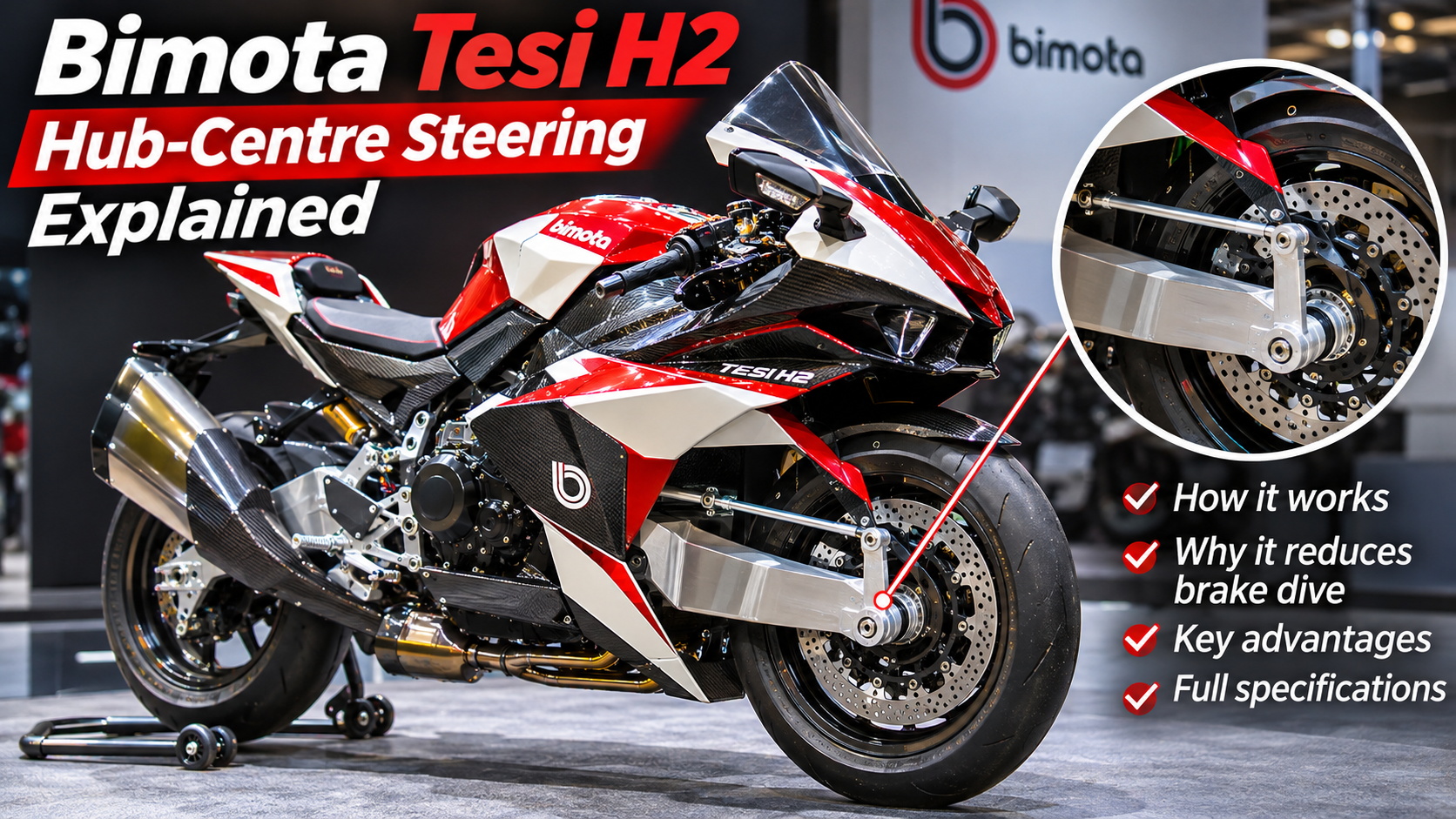
Instead of conventional telescopic front forks, the Tesi H2 uses an aluminium front swingarm, a steering pivot within the wheel hub, and a series of mechanical linkages. The goal is to separate suspension movement from steering control while reducing changes in chassis attitude during braking.

What Is Hub-Centre Steering?
Most motorcycles use telescopic forks that perform two major tasks: supporting the front suspension and steering the front wheel. Although this arrangement is effective and widely developed, braking and suspension forces act through the same fork assembly.
Hub-centre steering approaches the problem differently. The front wheel is carried by a swingarm, while a steering mechanism positioned within the wheel hub allows the wheel to turn independently of the suspension arm.
On the Tesi H2, the handlebars operate mechanical steering rods and joints. These linkages transfer rider input to the front hub, allowing the wheel to change direction while its supporting swingarm continues to manage suspension movement.
How the Bimota Tesi H2 Steering System Works
The system combines several carefully engineered components:
- Front swingarm: Supports the wheel and transfers suspension and braking loads into the motorcycle’s structure.
- Hub-centre pivot: Allows the wheel assembly to steer relative to the supporting swingarm.
- Steering linkages: Connect handlebar input to the hub steering mechanism.
- Öhlins shock absorber: Controls front suspension movement through a separate suspension mechanism.
- Carbon-fibre structural bridge: Connects parts of the front swingarm and contributes to chassis rigidity.
The front steering system allows approximately 27 degrees of movement in either direction, according to Bimota. The front and rear swingarms are mounted directly to the engine structure, giving the motorcycle its distinctive mechanical layout.

Why Hub-Centre Steering Reduces Brake Dive
When a rider applies the front brake on a conventional motorcycle, forward weight transfer typically compresses the telescopic forks. As the front suspension moves, the motorcycle’s steering geometry can change.
The Tesi H2’s swingarm arrangement is designed to resist some of this pitching motion through its pivot position and suspension geometry. This creates an anti-dive effect, helping maintain a more consistent chassis attitude under braking.
Reduced dive can help preserve steering geometry and limit abrupt changes in the motorcycle’s attitude when approaching corners. However, this does not eliminate weight transfer or guarantee superior braking performance in every situation.
Advantages and Challenges
Hub-centre steering offers several potential engineering benefits, including greater separation between steering and suspension forces, reduced brake dive, and additional flexibility in chassis design.
It also introduces compromises. Multiple steering joints, bearings, and mechanical linkages add complexity. The feedback reaching the handlebars can feel different from conventional forks, while maintenance may require specialist knowledge and components.
Consequently, hub-centre steering remains an unusual solution rather than an industry standard.
Hub-Centre Steering vs Telescopic Forks
| Feature | Tesi H2 | Conventional Forks |
|---|---|---|
| Front-wheel support | Swingarm | Telescopic fork legs |
| Steering | Hub pivot and linkages | Rotating fork assembly |
| Brake dive | Reduced by geometry | Generally more pronounced |
| System complexity | Higher | Generally lower |
| Steering feedback | Distinctive | Familiar to most riders |
Supercharged Kawasaki Engine
Behind the unusual chassis is a 998 cc liquid-cooled, supercharged inline-four engine derived from Kawasaki’s Ninja H2 platform.
It produces 170 kW (231 PS) at 11,500 rpm, with 178 kW (242 PS) quoted under ram-air conditions in Bimota’s technical information. Maximum torque is approximately 141.7 Nm at 11,000 rpm.
The engine works with a six-speed transmission and electronic rider-assistance technology, combining substantial performance with the unique handling characteristics of the Tesi chassis.
Bimota Tesi H2 Technical Specifications
| Engine | 998 cc supercharged inline-four |
| Maximum power | 170 kW (231 PS) |
| Ram-air power | 178 kW (242 PS) |
| Maximum torque | 141.7 Nm |
| Transmission | 6-speed |
| Front suspension | Billet aluminium swingarm, Öhlins TTX36 |
| Rear suspension | Billet aluminium swingarm, Öhlins TTX36 |
| Front travel | 100 mm |
| Rear travel | 130 mm |
| Front brakes | Dual 330 mm discs, Brembo Stylema calipers |
| Seat height | 840 mm, adjustable |
| Fuel tank | 17 litres |
Specifications are based on Bimota’s published technical information. Certain dimensions and mass figures vary between published versions and markets.
A Motorcycle Built Around Engineering Innovation

The Tesi concept has long represented Bimota’s willingness to explore alternatives to traditional motorcycle engineering. The original Tesi 1D established the production lineage in 1990, while the Tesi H2 brought the concept into the era of supercharged superbikes.
Unveiled at EICMA in 2019, the Tesi H2 combined Italian craftsmanship, machined aluminium components, carbon-fibre bodywork, and Kawasaki’s extraordinary engine technology.
Conclusion: Is Hub-Centre Steering Better?
The Bimota Tesi H2 proves that high-performance motorcycle engineering does not need to follow the conventional telescopic-fork formula.
Its hub-centre steering system separates steering and suspension mechanisms, reduces brake dive through its geometry, and provides a distinctive alternative approach to front-wheel control.
Yet the advantages come with greater mechanical complexity and a different steering feel. Whether it is preferable to a conventional superbike depends on the rider, the conditions, and the priorities of the design.
Above all, the Tesi H2 stands as a remarkable example of engineering experimentation: a motorcycle designed not simply to go fast, but to reconsider how a motorcycle should steer.
Sources
- Bimota — Official Tesi H2 Information and Specifications
- Bimota Japan — Tesi H2 Technical Specifications
- Wikimedia Commons — Bimota Tesi H2 Photography
Photography is credited individually. Original photographs are reproduced without intentional alteration under their respective Creative Commons licenses.