
Views: 1
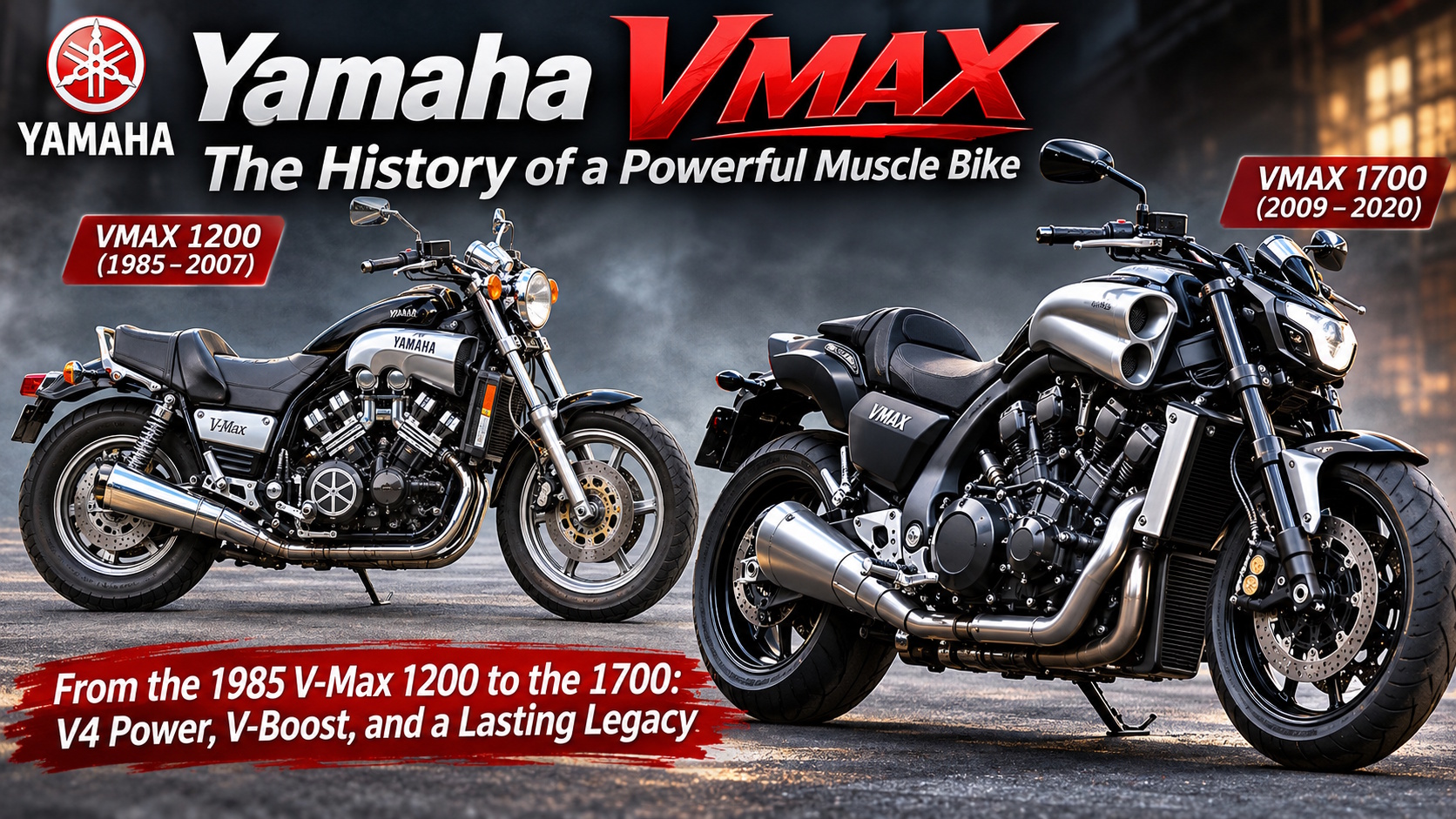
Yamaha VMAX: The History of a Powerful Muscle Bike

The Yamaha VMAX is one of the most iconic muscle motorcycles ever created. Famous for its powerful V4 engine, aggressive styling, and outstanding acceleration, the VMAX challenged traditional cruiser design and became a legend among motorcycle enthusiasts.
From its introduction in 1985 to the final years of production, the VMAX represented Yamaha’s commitment to unconventional engineering and raw performance. Its combination of cruiser ergonomics and drag-racing-inspired acceleration created a motorcycle unlike almost anything else on the road.
1. The Birth of the Yamaha V-Max in 1985

Yamaha introduced the original V-Max in 1985 for the American market. Instead of creating another conventional touring or cruiser motorcycle, Yamaha developed a machine that prioritized powerful acceleration and distinctive engineering.
The motorcycle featured a 1,198cc liquid-cooled, four-stroke V4 engine. Its prominent intake covers, exposed engine, muscular silhouette, wide rear tire, and compact riding position helped make the V-Max instantly recognizable.
The original model became an international success. According to Yamaha, approximately 100,000 units had been produced by the end of 2007.
2. The Revolutionary V-Boost Engine System
One of the most remarkable features of the original Yamaha V-Max was its innovative V-Boost intake system.
V-Boost used electronically controlled butterfly valves to connect intake passages between pairs of cylinders. The valves began opening at approximately 5,750 rpm, helping the V4 engine breathe more effectively at higher engine speeds.
This produced the dramatic surge of acceleration that became one of the motorcycle’s defining characteristics.
Unlike a turbocharger, V-Boost did not compress the incoming air. Instead, it improved the engine’s high-speed intake performance through its specially designed intake passages.
Yamaha stated that V-Boost increased the base engine’s maximum power output by approximately 10 percent.
3. Yamaha V-Max 1200 Specifications
| Specification | Yamaha V-Max 1200 |
|---|---|
| Introduced | 1985 |
| Engine | 1,198cc liquid-cooled V4 |
| Valvetrain | DOHC, 16 valves |
| Maximum power | Approximately 145 PS (full-power version) |
| Fuel system | Four carburetors with V-Boost |
| Transmission | 5-speed manual |
| Final drive | Shaft |
| Original generation | 1985–2007 |
Note: Specifications varied by model year and market.
4. The 2009 Yamaha VMAX 1700: A New Generation

For the 2009 model year, Yamaha introduced a completely redesigned VMAX after more than two decades of the original generation.
The new motorcycle maintained the muscular styling and straight-line performance philosophy of its predecessor while incorporating substantial technical improvements.
Its larger 1,679cc liquid-cooled V4 engine produced approximately 200 metric horsepower, making it one of the most powerful production power cruisers of its era.
Major technologies included:
- YCC-T: Yamaha Chip Controlled Throttle, an electronically controlled throttle system.
- YCC-I: Yamaha Chip Controlled Intake, which adjusted intake characteristics according to operating conditions.
- Electronic fuel injection: Replacing the original carburetor-based fuel delivery.
- Aluminum frame: A redesigned structure intended to improve rigidity and handling.
- Advanced braking and suspension: Supporting the new motorcycle’s performance capabilities.
The second-generation VMAX was not simply a larger version of the original. It was an extensively redesigned motorcycle intended to combine extraordinary acceleration with more modern chassis engineering.
5. Yamaha VMAX 1200 vs VMAX 1700
| Feature | VMAX 1200 | VMAX 1700 |
|---|---|---|
| Introduction | 1985 | 2009 |
| Displacement | 1,198cc | 1,679cc |
| Power | ~145 PS | ~200 PS |
| Fuel delivery | Carburetors | Fuel injection |
| Intake system | V-Boost | YCC-I |
| Throttle | Mechanical | Electronic YCC-T |
| Frame | Steel | Aluminum |
| Final drive | Shaft | Shaft |
Both generations shared the same philosophy, but the later VMAX offered considerably more advanced electronics, greater engine output, and a modernized chassis.
6. What Made the VMAX Unique?

Powerful V4 Engine
The V4 engine gave the VMAX a distinctive mechanical character, combining strong power delivery with an unmistakable sound.
Aggressive Muscle-Bike Styling
Its imposing engine, sculpted bodywork, prominent intake covers, and substantial rear tire created a visual identity that survived both generations.
Shaft-Driven Rear Wheel
Yamaha selected shaft drive instead of the chain drive common on many high-performance motorcycles. This provided durability and reduced routine chain-related maintenance.
Emphasis on Acceleration
Unlike lightweight sport motorcycles, the VMAX prioritized powerful straight-line performance. Its engineering and styling reflected that purpose.
7. The End of Yamaha VMAX Production
As motorcycle markets evolved, increasingly demanding emissions regulations and changing consumer preferences made specialized high-displacement models more difficult to sustain.
The VMAX eventually reached the end of its production life, with sales concluding in different markets at different times. The final model years extended to 2020 in the United States.
Its discontinuation closed a chapter in Yamaha’s motorcycle history, but the machine’s reputation remained strong among enthusiasts.
8. Advantages and Disadvantages
Advantages
- Outstanding straight-line acceleration.
- Distinctive V4 engine sound and character.
- Bold, instantly recognizable styling.
- Durable shaft-drive system.
- Strong collector and enthusiast appeal.
Disadvantages
- Substantial weight compared with sport motorcycles.
- Limited fuel range, particularly when ridden aggressively.
- Less agile handling on tight roads.
- Potentially expensive specialized replacement parts.
- High-performance characteristics that demand experienced riders.
9. Who Should Buy a Yamaha VMAX?
The Yamaha VMAX is particularly appealing to experienced riders who value powerful engines, unique design, and motorcycle history.
Collectors may prefer the first-generation V-Max 1200 for its classic styling and historically important V-Boost technology.
Riders seeking stronger acceleration and more modern engine management may prefer the VMAX 1700.
However, its weight and powerful acceleration make the VMAX unsuitable as an ideal first motorcycle for inexperienced riders.
10. The Legacy of Yamaha’s Muscle-Bike Icon
Few motorcycles have maintained such a distinct identity over several decades.
The Yamaha VMAX demonstrated that a motorcycle could combine cruiser-style ergonomics, unconventional engineering, and extraordinary engine performance.
From the original 1985 V-Max 1200 to the second-generation 1,679cc VMAX, Yamaha continued to refine a concept built around muscular styling and thrilling acceleration.
Although the Yamaha VMAX is no longer in production, its legacy lives on as one of the most memorable Japanese muscle motorcycles ever created.
Sources and Image Credits
Technical and historical references:
- Yamaha Motor — 1985 VMAX 1200 History
- Yamaha Motor — 2009 VMAX Launch
- Yamaha Communication Plaza — VMAX
Photographs: loic33000 (CC BY-SA 3.0); Dédélembrouille (CC BY-SA 3.0); Cjp24 (CC BY-SA 4.0); Sanfilm (CC BY 4.0). Photographs displayed without modification; respective Creative Commons licenses apply.