
Views: 0
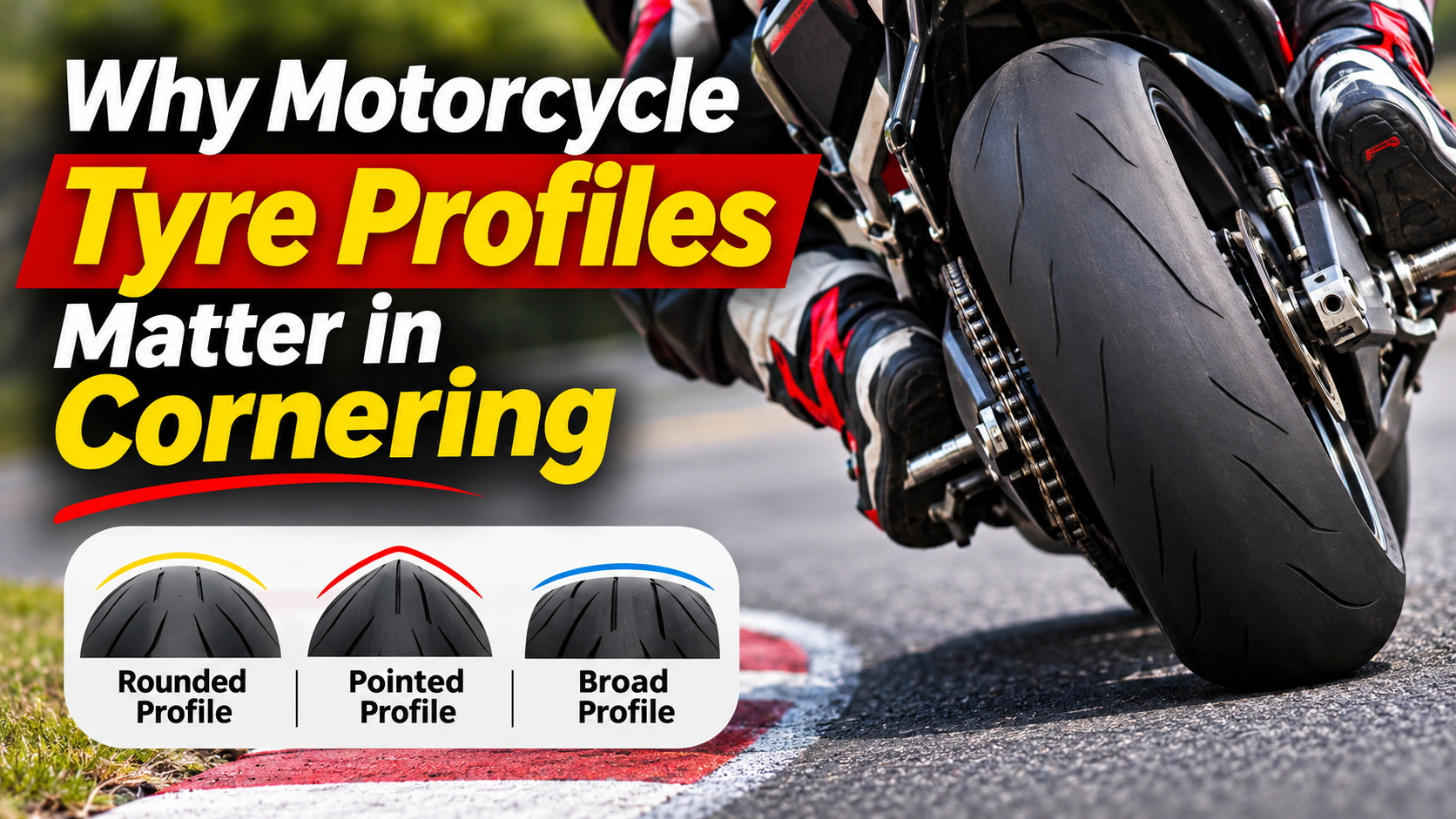
Why Motorcycle Tyre Profiles Matter in Cornering
Motorcycle Engineering | Bin3aiah Motors

Motorcycle tyres do much more than provide traction. Their shape plays a critical role in steering response, lean transitions, stability and cornering performance.
Unlike most car tyres, motorcycle tyres have curved tread profiles designed to operate across a wide range of lean angles. This curvature influences how the tyre interacts with the road as the motorcycle changes direction.
Understanding tyre profiles helps explain why two motorcycles with similar engines and chassis specifications can feel very different through corners.
1. What Is a Motorcycle Tyre Profile?
A motorcycle tyre profile is the curved shape of the tread when the tyre is viewed in cross-section.
As the motorcycle leans, different regions of the tread contact the road. The curvature affects how the contact patch moves, how steering forces develop and how the motorcycle responds to rider input.
Three general profile characteristics are particularly important:
Rounded Profiles
Rounded profiles typically offer smooth, progressive steering behaviour. They are commonly associated with road and touring applications where predictable transitions into corners are desirable.
Pointed or Triangular Profiles
More pointed profiles are often associated with sport-focused tyres. Depending on the complete tyre design, they can produce a quicker turn-in response and a more agile feeling during changes of direction.
Broad or Flatter Profiles
Broad profiles may provide a stable sensation when travelling upright. However, flatter contours can require additional steering effort when moving into a lean.
Important: These descriptions are general tendencies. Tyre construction, dimensions, pressure, motorcycle geometry and load all affect actual handling.
2. How Tyre Profiles Affect Cornering
When a rider initiates a turn, steering inputs cause the motorcycle to lean. As the lean angle changes, the tyre’s curved tread alters the position and characteristics of the contact patch.
The profile influences steering torque, tyre-generated forces and the way the motorcycle responds through the corner.
- Initial turn-in: Some profiles allow the motorcycle to respond more quickly to steering inputs.
- Mid-corner stability: The contour influences the feel and steering corrections required while the motorcycle is leaned over.
- Lean transitions: Profile geometry affects how smoothly the motorcycle moves between upright and leaned positions.
- Rider confidence: Predictable steering feedback makes it easier for riders to judge the motorcycle’s response.
Sharper steering is not automatically superior. A very responsive setup may feel less relaxed during everyday riding, while progressive steering can be advantageous on imperfect road surfaces.
3. Understanding the Contact Patch

The contact patch is the area of the tyre touching the road at a particular moment.
During cornering, this contact region changes in position and shape as the motorcycle leans and forces act through the tyre.
Important factors influencing the contact patch include:
- Tyre profile and dimensions
- Inflation pressure
- Rubber compound and carcass construction
- Motorcycle and rider weight
- Lean angle and suspension loading
- Braking, acceleration and cornering forces
A larger contact patch does not automatically produce more grip. Friction depends on several interacting factors, including the compound, road surface, temperature and the loads applied to the tyre.
During aggressive cornering, the available traction must support lateral forces while also accommodating any braking or acceleration.
4. Sport Tyres Versus Touring Tyres
Tyre manufacturers develop different combinations of tread contour, compound and construction to suit various riding requirements.
| Characteristic | Sport Tyres | Touring Tyres |
|---|---|---|
| Steering | Often quicker | Often progressive |
| Profile | May be more pointed | Often more rounded |
| Design priorities | Precision and sport performance | Stability, versatility and durability |
| Typical use | Sport riding and track-oriented applications | Commuting and long-distance travel |
Modern sport-touring tyres can combine responsive cornering with excellent durability and wet-weather capability. These distinctions should therefore be treated as broad trends rather than strict rules.
5. Why Worn Tyres Change Handling
As tyres wear, their original contours gradually change.
Motorcycles used extensively on highways may develop a flattened central section on the rear tyre. The transition between the flat centre and curved shoulder can make steering feel less smooth.
Possible handling symptoms include:
- Increased steering effort when entering corners
- Less consistent lean transitions
- Unusual steering feedback
- Reduced confidence during cornering
Uneven front tyre wear can also influence steering precision and stability.
This explains why installing new tyres can noticeably improve a motorcycle’s handling even when the replacement tyres are the same model.
6. Tyre Pressure and Cornering Performance

Even an advanced tyre profile cannot deliver its intended performance when the inflation pressure is incorrect.
Underinflation can increase tyre deformation and heat generation, making steering feel sluggish or imprecise.
Overinflation can reduce tyre compliance over uneven surfaces and affect traction and ride comfort.
Correct pressure helps the tyre operate closer to its intended shape and construction characteristics.
For normal road riding, use the motorcycle manufacturer’s specified cold tyre pressures, accounting for passenger and luggage loads where applicable.
Track riding can require different pressure recommendations depending on the tyre model and conditions. Always follow the relevant manufacturer’s guidance.
7. Front and Rear Tyre Profiles
The front and rear tyres have different responsibilities.
Front Tyre
The front tyre strongly influences steering precision, directional feedback and braking control.
Rear Tyre
The rear tyre transmits engine power to the road while contributing to cornering stability and supporting a significant portion of the motorcycle’s load.
Manufacturers design compatible front and rear tyres to work together with the motorcycle’s chassis geometry.
Using unapproved sizes or incompatible tyre combinations can change handling characteristics and may compromise safety.
8. Choosing the Right Tyre Profile
The ideal tyre depends on how and where the motorcycle is used.
- Daily commuting: Prioritise predictable steering, durability and wet-road performance.
- Sport riding: Look for suitable tyres offering responsive handling and appropriate grip for the intended conditions.
- Touring: Consider stability, load capacity, comfort and consistent performance over long distances.
- Track riding: Use tyres suitable for the motorcycle, circuit conditions and rider ability.
Tyre profile should never be judged in isolation. Always consider approved dimensions, compound, construction, load rating and speed rating.
Conclusion
Motorcycle tyre profiles are a fundamental part of cornering performance.
They influence how the motorcycle responds to steering inputs, how the contact patch moves during lean and how stable or agile the machine feels through corners.
A pointed profile may produce a quicker steering sensation, while a rounded contour may offer smoother transitions. Neither is automatically the best choice for every motorcycle or rider.
The best handling comes from a balanced combination of tyre geometry, compound, construction, pressure, motorcycle setup and riding technique.
References and Further Reading
Image Credits and Licences
- Motorcycle Lean PPIHC — Hustvedt, Wikimedia Commons, CC BY-SA 3.0.
- Tire tread — Clearly Ambiguous, Wikimedia Commons, CC BY 2.0.
- Motorcycle wheel close up — Public Domain Images, Wikimedia Commons, public domain.
Editorial note: This article provides general technical information and does not replace motorcycle or tyre manufacturer instructions.