
Views: 0
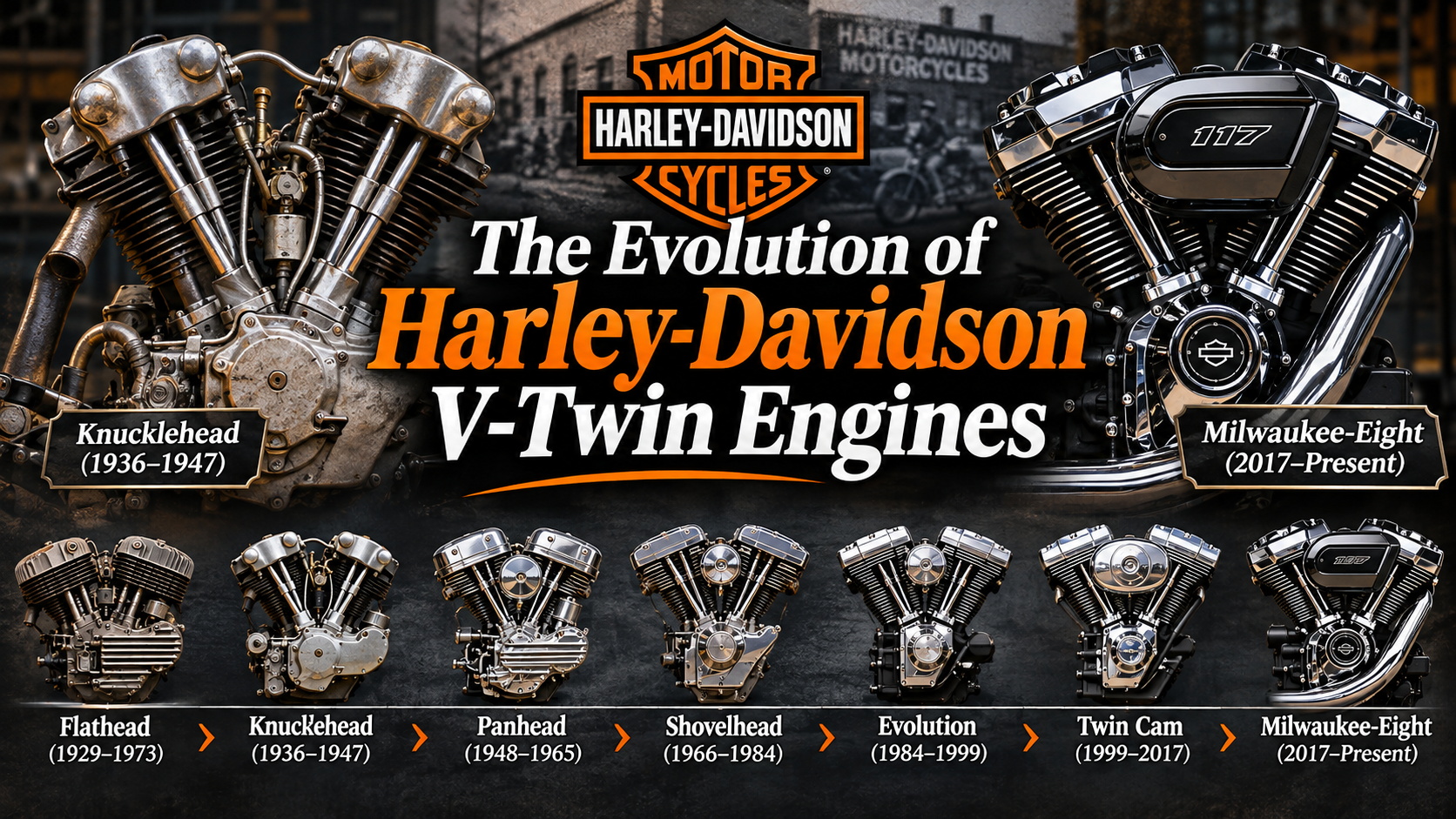
The Evolution of Harley-Davidson V-Twin Engines
Few engines in motorcycle history are as recognizable as the Harley-Davidson V-twin. Its distinctive cylinder arrangement, unmistakable exhaust rhythm, and torque-rich performance have helped define American motorcycling for more than a century.
Since its introduction in 1909, the Harley-Davidson V-twin has undergone a remarkable transformation. Early engines relied on simple mechanical systems, while modern designs incorporate sophisticated electronic controls, advanced cooling, improved combustion efficiency, and variable valve timing.
Here is the evolution of Harley-Davidson V-twin engines, from the earliest designs to the powerful Milwaukee-Eight and Revolution Max families.
1. The First V-Twin and F-Head Era (1909–1929)
Harley-Davidson introduced its first V-twin in 1909. This 49.5-cubic-inch (approximately 811cc) engine featured two cylinders arranged at a 45-degree angle and generated around seven horsepower.
The original design used atmospheric intake valves that opened through engine vacuum. Although innovative for its time, the system was unreliable and the engine was offered for only one year.
In 1911, Harley-Davidson introduced an improved F-Head V-twin. Its more dependable valvetrain and ignition system established the foundation for the company’s early commercial success.
The F-Head initially displaced 61 cubic inches, with larger 74-cubic-inch versions appearing later. It powered motorcycles used for racing, touring, policing, and commercial transportation.
2. Flathead: Built for Durability (1929–1973)

The Flathead engine arrived in 1929 and became one of Harley-Davidson’s longest-serving engine families.
Its side-valve configuration placed the intake and exhaust valves beside the cylinders rather than above them. This simplified the cylinder-head design and contributed to durability and ease of maintenance.
The early 45-cubic-inch Flathead was joined by larger 74- and 80-cubic-inch versions. The engine powered civilian motorcycles, military models, and the legendary Servi-Car utility tricycle.
During World War II, Flathead-powered WLA motorcycles became especially important for military transportation.
Although overhead-valve engines eventually offered superior performance, the Flathead remained in certain Harley-Davidson applications until 1973.
3. Knucklehead: The Overhead-Valve Revolution (1936–1947)

Introduced in 1936, the Knucklehead marked a major turning point in Harley-Davidson engineering.
Unlike the earlier Flathead, the Knucklehead featured overhead valves operated by pushrods. This improved airflow through the cylinder heads and supported greater power output.
The engine retained Harley-Davidson’s characteristic 45-degree V-twin layout. Its distinctive rocker-arm covers resembled clenched fists, inspiring the Knucklehead nickname.
Initially introduced with 61 cubic inches of displacement, it later appeared in a 74-cubic-inch configuration.
The Knucklehead established much of the architecture that would influence Harley-Davidson’s traditional Big Twin engines for decades.
4. Panhead: Improved Cooling and Reliability (1948–1965)

In 1948, Harley-Davidson replaced the Knucklehead with the Panhead, introducing several important engineering improvements.
The new engine featured aluminum cylinder heads, hydraulic valve lifters, improved lubrication, and updated crankshaft components.
Aluminum heads helped dissipate combustion heat more effectively, while hydraulic lifters reduced the need for frequent valve adjustments.
The Panhead retained the 61- and 74-cubic-inch displacement options of its predecessor. Its nickname came from the smooth, pan-shaped rocker covers.
During the 1950s and early 1960s, Panhead-powered motorcycles became symbols of American touring and custom motorcycle culture.
5. Shovelhead: More Power for the Modern Cruiser (1966–1984)

The Shovelhead arrived in 1966 with redesigned cylinder heads and improvements to the traditional overhead-valve Big Twin configuration.
Its combustion-chamber and cylinder-head changes helped deliver stronger performance than the previous generation.
Early Shovelhead engines displaced 74 cubic inches, while later versions grew to 80 cubic inches.
As motorcycles became heavier and riders demanded greater touring capability, increased torque became increasingly important.
The Shovelhead developed a reputation for mechanical character and classic styling. However, oil leaks, heat management, and maintenance requirements could be concerns, particularly on neglected examples.
Today, the Shovelhead remains popular among collectors and custom motorcycle builders.
6. Evolution: A New Standard of Reliability (1984–1999)

The Evolution engine, introduced in 1984, was one of the most important mechanical developments in Harley-Davidson’s modern history.
Known as the Evo, the 1,340cc Big Twin featured redesigned aluminum cylinders and cylinder heads, improved oil sealing, more precise manufacturing, and better heat management.
These upgrades addressed many of the reliability and maintenance problems associated with earlier engines.
The Evolution preserved the classic air-cooled, 45-degree pushrod V-twin configuration while offering a more dependable ownership experience.
A separate Evolution engine family also powered Sportster models beginning in 1986, continuing long after production of the Evolution Big Twin ended.
7. Twin Cam: Greater Torque and Refinement (1999–2017)

Harley-Davidson introduced the Twin Cam 88 for the 1999 model year, bringing substantial changes to the Big Twin engine family.
The design used two camshafts rather than the single camshaft arrangement found in earlier generations.
Initial displacement was 88 cubic inches, approximately 1,450cc. Later versions included the Twin Cam 96, 103, and 110.
Other developments included improved cylinder-head airflow, updated electronic fuel injection on equipped models, and counterbalancing in selected applications.
The Twin Cam powered popular Harley-Davidson motorcycles during a period when touring comfort, engine displacement, and highway performance became increasingly important.
8. Milwaukee-Eight: Modernizing the Classic Big Twin (2017–Present)

The Milwaukee-Eight entered production for the 2017 model year and represented one of the most comprehensive redesigns of Harley-Davidson’s traditional Big Twin engine.
The name refers to the engine’s eight valves, with four valves per cylinder. This arrangement improves airflow and combustion compared with earlier two-valve designs.
Although the Twin Cam used two camshafts, the Milwaukee-Eight returned to a single-camshaft layout.
Additional innovations included counterbalancing, improved cooling strategies, reduced mechanical noise, and more sophisticated engine management.
Initial versions included 107- and 114-cubic-inch engines. Larger versions followed, including 117- and 121-cubic-inch configurations.
Variable valve timing, introduced on selected Milwaukee-Eight models in 2023, further improved the engine’s ability to balance torque, performance, and efficiency across different operating speeds.
Despite these advancements, the Milwaukee-Eight preserves the familiar 45-degree V-twin appearance and the strong low-speed torque associated with Harley-Davidson cruisers and touring motorcycles.
9. Revolution and Revolution Max: A New Engineering Philosophy

Harley-Davidson also developed performance-oriented V-twin engines that departed significantly from its traditional air-cooled Big Twin architecture.
The Revolution engine, introduced with the V-Rod in 2002, used liquid cooling, double overhead camshafts, four valves per cylinder, and a 60-degree cylinder angle.
Developed with engineering assistance from Porsche, the Revolution emphasized higher engine speeds and stronger top-end performance.
In 2021, Harley-Davidson introduced the Revolution Max platform in motorcycles including the Pan America adventure model and Sportster S.
The Revolution Max features liquid cooling, double overhead camshafts, variable valve timing, electronic fuel injection, and a 60-degree V-twin arrangement.
Unlike the company’s traditional Big Twins, the Revolution Max also acts as a structural component of the motorcycle chassis, helping reduce weight and improve packaging efficiency.
This engine family demonstrates how Harley-Davidson continues to expand beyond conventional cruiser engineering.
Harley-Davidson V-Twin Engine Evolution Timeline
| Engine | Introduced | Key Development |
|---|---|---|
| Atmospheric V-Twin | 1909 | 45-degree cylinder arrangement |
| F-Head | 1911 | Improved valvetrain and reliability |
| Flathead | 1929 | Durable side-valve construction |
| Knucklehead | 1936 | Overhead-valve Big Twin architecture |
| Panhead | 1948 | Aluminum heads and hydraulic lifters |
| Shovelhead | 1966 | Improved heads and performance |
| Evolution Big Twin | 1984 | Reliability and thermal improvements |
| Twin Cam | 1999 | Dual camshafts and greater displacement |
| Revolution | 2002 | Liquid-cooled DOHC V-twin |
| Milwaukee-Eight | 2017 | Eight valves and counterbalancing |
| Revolution Max | 2021 | Variable valve timing and structural integration |
Why Harley-Davidson V-Twin Engines Sound So Distinctive
The traditional Harley-Davidson exhaust rhythm is closely related to its 45-degree V-twin configuration and shared crankpin design.
In a conventional four-stroke engine, each cylinder completes its operating cycle over 720 degrees of crankshaft rotation.
With the traditional Harley-Davidson arrangement, combustion events occur at uneven intervals of approximately 315 and 405 degrees.
These uneven firing intervals contribute to the distinctive exhaust pulse pattern associated with classic Harley-Davidson motorcycles.
Engine speed, camshaft profiles, exhaust systems, and other mechanical factors also influence the final sound. Modern counterbalancers can make the ride smoother without fundamentally changing the firing pattern.
The Future of Harley-Davidson V-Twin Engineering
The Milwaukee-Eight and Revolution Max illustrate two different approaches to the future of Harley-Davidson engine development.
The Milwaukee-Eight continues the traditional Big Twin formula, emphasizing torque, refinement, recognizable styling, and the familiar Harley-Davidson riding experience.
The Revolution Max prioritizes higher engine speeds, advanced valve timing, liquid cooling, lighter construction, and versatile motorcycle applications.
As emissions requirements, rider expectations, and motorcycle technology continue to evolve, both engineering approaches demonstrate how the V-twin can adapt without abandoning its historical significance.
Conclusion
The evolution of Harley-Davidson V-twin engines is a story of continuous mechanical development.
From the simple atmospheric-valve engine of 1909 to the overhead-valve Knucklehead, refined Panhead, durable Evolution, powerful Twin Cam, and modern Milwaukee-Eight, every generation introduced changes that influenced the next.
The Revolution and Revolution Max families expanded Harley-Davidson’s engineering possibilities even further through liquid cooling, sophisticated valvetrain technology, and performance-focused design.
More than a century after its introduction, the V-twin remains one of the most important symbols in Harley-Davidson’s history and an enduring feature of motorcycle engineering.
References and Image Credits
Historical and technical references:
- Harley-Davidson — History of Engine Types
- Wikimedia Commons — Harley-Davidson Museum Engine Collection
Engine photographs: Michael Barera, Wikimedia Commons. Licensed under Creative Commons Attribution-ShareAlike 4.0 International. Images have not been intentionally modified. See the individual Wikimedia Commons file descriptions for full attribution and reuse information.