
Views: 0
BMW HP4 Race: Carbon-Fibre Motorcycle Engineering
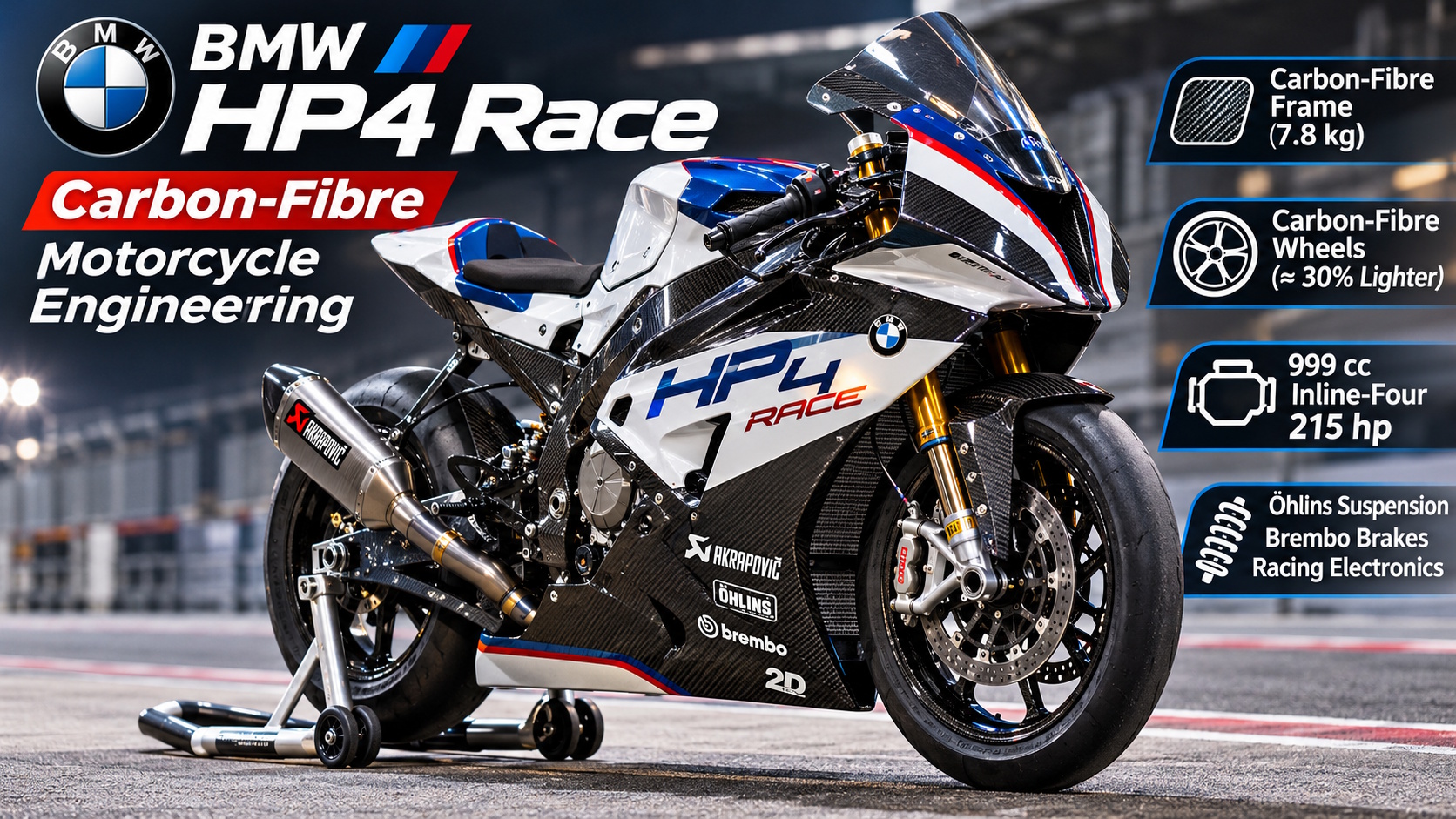
The BMW HP4 Race is one of the most extraordinary track-only superbikes ever developed by BMW Motorrad. Introduced in 2017, it combined revolutionary carbon-fibre construction with World Superbike-derived engineering and an exceptionally lightweight design.

Limited to just 750 individually numbered motorcycles, the HP4 Race was never intended for ordinary roads. Instead, BMW created an exclusive racing machine to demonstrate what advanced materials, precise chassis engineering and competition-grade components could achieve.
BMW HP4 Race Technical Specifications
| Specification | BMW HP4 Race |
|---|---|
| Year | 2017 |
| Engine | 999 cc inline-four |
| Maximum Power | 215 hp at 13,900 rpm |
| Peak Torque | 120 Nm at 10,000 rpm |
| Transmission | 6-speed racing gearbox |
| Main Frame | Carbon-fibre monocoque |
| Frame Weight | 7.8 kg |
| Wet Weight | 171 kg |
| Wheels | Carbon-fibre |
| Front Suspension | Öhlins FGR 300 |
| Rear Suspension | Öhlins TTX 36 GP |
| Production | 750 units |
| Road Legal | No — track use only |
1. Carbon-Fibre Monocoque Frame: A Motorcycle Engineering Revolution
The HP4 Race’s greatest technological achievement is its carbon-fibre main frame, weighing only 7.8 kilograms.
Unlike traditional aluminium motorcycle frames, this innovative structure uses carbon-fibre-reinforced polymer manufactured through a Resin Transfer Moulding process.
Carbon fibres are positioned within a mould and combined with resin to create a precisely engineered, rigid and lightweight structural component.
Advantages of the Carbon-Fibre Frame
- Significantly reduced structural weight.
- Precisely engineered stiffness characteristics.
- High structural strength relative to weight.
- Reduced motorcycle mass and increased agility.
- Greater freedom in designing structural components.
BMW’s achievement was particularly significant because it demonstrated how an entirely carbon-fibre motorcycle main frame could be manufactured industrially in a limited production series.
2. Carbon-Fibre Wheels and Their Performance Benefits
Beyond the frame, the HP4 Race features lightweight carbon-fibre wheels designed to improve handling, steering and acceleration response.
BMW reported that these wheels were approximately 30 percent lighter than comparable forged light-alloy wheels.
Lower rotational inertia helps the motorcycle change direction more quickly. Reduced unsprung mass can also improve suspension response, particularly during demanding racetrack conditions.
These improvements are especially important for professional riders who need precise handling during rapid cornering transitions.
3. The 999 cc Racing Engine
The BMW HP4 Race is powered by a 999 cc liquid-cooled inline-four engine based on BMW’s high-performance superbike racing technology.
Producing 215 horsepower at 13,900 rpm and 120 Nm of torque at 10,000 rpm, the engine delivers exceptional performance for a motorcycle of its weight.
Key Engine Features
- High-performance inline-four configuration.
- Race-oriented engine calibration.
- Six-speed close-ratio racing gearbox.
- Electronic quickshifting system.
- Lightweight titanium Akrapovič exhaust system.
- High-revving power delivery designed for circuit riding.
With approximately 1.26 horsepower per kilogram of wet weight, the HP4 Race offers a remarkable combination of acceleration potential and lightweight engineering.
4. Racing Suspension and Braking Technology
BMW equipped the HP4 Race with premium motorsport components comparable to those used by professional racing teams.
The front suspension uses Öhlins FGR 300 racing forks, while an Öhlins TTX 36 GP shock absorber manages rear suspension movement.
The motorcycle also features Brembo GP4 RR racing brake calipers, offering exceptional braking performance and control.
Adjustable Chassis Geometry
Its sophisticated chassis allows adjustments to steering geometry, swingarm pivot position and rider ergonomics.
This flexibility enables experienced riders and mechanics to adapt the motorcycle’s handling characteristics to different circuits, tyres and riding styles.
5. Advanced Racing Electronics
Despite its emphasis on lightweight mechanical engineering, the BMW HP4 Race incorporates sophisticated electronic rider-assistance systems.
- Dynamic Traction Control.
- Engine Brake Regulation.
- Wheelie Control.
- Launch Control.
- Pit-Lane Speed Limiter.
- Four selectable engine modes.
- 2D racing dashboard and data recording.
These systems help the rider manage engine output, rear-wheel traction and braking behaviour during intense track riding.
6. Lightweight Engineering and Performance

At approximately 171 kilograms with fuel, the HP4 Race demonstrates the importance of reducing mass throughout a motorcycle’s design.
Rather than focusing exclusively on horsepower, BMW combined a lightweight frame, carbon-fibre wheels, racing suspension and carefully selected components.
Lower overall weight can improve acceleration, braking response and agility, while reduced rotational mass contributes to more responsive handling.
7. BMW HP4 Race: Advantages and Disadvantages
Advantages
- Groundbreaking carbon-fibre frame technology.
- Outstanding power-to-weight ratio.
- Extremely lightweight carbon-fibre wheels.
- Professional racing suspension and brakes.
- Highly adjustable chassis geometry.
- Exclusive production of only 750 motorcycles.
- Advanced electronic racing systems.
Disadvantages
- Not legal for public-road use.
- Exceptionally expensive compared with conventional superbikes.
- Specialist maintenance requirements.
- Limited availability of bespoke components.
- Uncompromising ergonomics and performance.
- Not suitable for inexperienced motorcycle riders.
8. Who Is the BMW HP4 Race Designed For?
The BMW HP4 Race is designed primarily for experienced track-day riders, professional racing enthusiasts, collectors and motorcycle engineering specialists.
Its advanced technology rewards riders capable of understanding racing suspension, electronic settings and chassis adjustment.
For collectors, its limited production and historical importance also make it an exceptional example of BMW Motorrad’s engineering capabilities.
9. BMW HP4 Race Official Video
Explore the HP4 Race’s construction, racing components and engineering details in this official BMW Motorrad presentation.
10. The Legacy of the BMW HP4 Race
The BMW HP4 Race represents a milestone in the evolution of high-performance motorcycles.
Its carbon-fibre monocoque frame demonstrated that advanced composite materials could become practical structural components in limited-production motorcycles.
More importantly, the HP4 Race showed that exceptional motorcycle performance depends on a complete engineering approach involving weight, chassis stiffness, suspension, braking and electronic control.
Conclusion
The BMW HP4 Race remains one of BMW Motorrad’s most remarkable engineering achievements.
With its 215-horsepower engine, 7.8-kilogram carbon-fibre frame, lightweight wheels and competition-grade components, it established an extraordinary standard for limited-production track motorcycles.
It is more than a superbike: it is an engineering demonstration of what becomes possible when advanced materials and professional racing technology are brought together without the compromises required for everyday road use.
References and Image Credits
- BMW Group — The New BMW HP4 Race
- BMW Group — HP4 Race Official Photo Gallery
- Wikimedia Commons — HP4 Race Photograph and Licence
Published by Bin3aiah Motors