
Views: 0
Ducati Diavel V4: The Engineering of a Power Cruiser
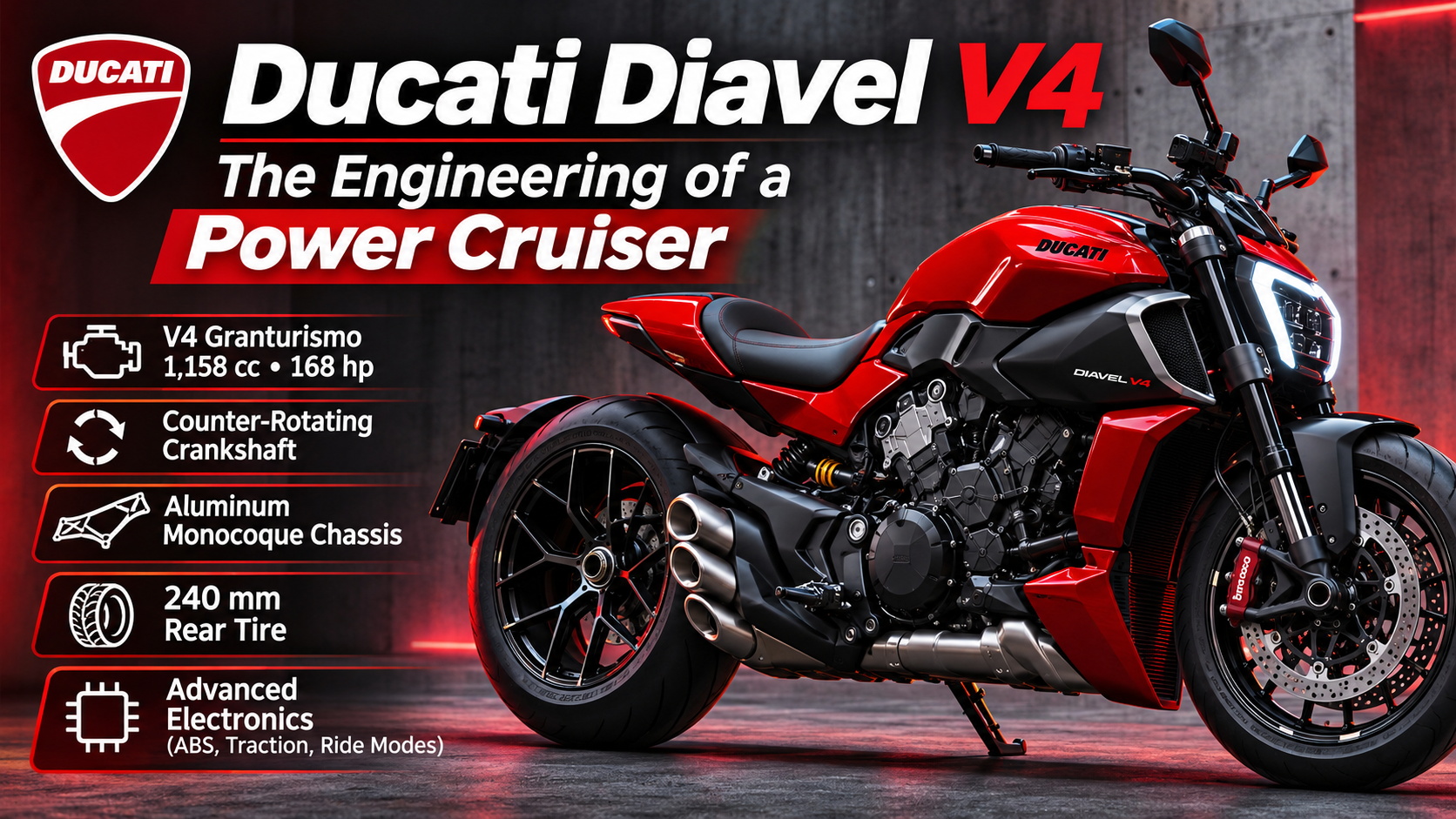
The Ducati Diavel V4 combines the muscular styling of a power cruiser with the advanced engineering of a high-performance sport motorcycle. Its 1,158 cc V4 Granturismo engine, aluminum monocoque chassis, counter-rotating crankshaft and sophisticated electronics create a motorcycle designed for powerful acceleration, confident handling and everyday usability.

Technical Specifications
| Engine | 1,158 cc V4 Granturismo |
|---|---|
| Engine configuration | 90-degree V4, liquid-cooled |
| Maximum power | 168 hp at 10,750 rpm |
| Maximum torque | 126 Nm at 7,500 rpm |
| Transmission | 6-speed with Ducati Quick Shift |
| Frame | Aluminum monocoque |
| Front suspension | 50 mm fully adjustable inverted fork |
| Rear suspension | Fully adjustable monoshock |
| Front brakes | Dual 330 mm discs, Brembo Stylema |
| Rear tire | 240/45 ZR17 |
| Seat height | 790 mm |
| Dry weight | 211 kg |
| Fuel capacity | 20 liters |
1. The V4 Granturismo Engine
At the heart of the Diavel V4 is Ducati’s 1,158 cc V4 Granturismo engine. Unlike traditional cruiser engines that often emphasize low-rpm torque, Ducati engineered this powerplant to provide strong midrange acceleration and impressive high-rpm performance.
Producing 168 hp and 126 Nm of torque, the engine uses a Twin Pulse firing order, electronic fuel injection and ride-by-wire throttle control. Its compact V4 configuration also contributes to the motorcycle’s distinctive mechanical character.
One of its most innovative features is extended rear-cylinder deactivation. At low engine loads, the rear cylinder bank can temporarily shut down, reducing fuel consumption and heat. When greater acceleration is demanded, the engine returns to four-cylinder operation.
2. Counter-Rotating Crankshaft Technology
The Diavel V4 uses a counter-rotating crankshaft, a technology also associated with Ducati’s racing and high-performance motorcycle development.
By rotating opposite to the wheels, the crankshaft helps counteract some of their gyroscopic effects. This can reduce the effort required to change direction and influence the motorcycle’s response during acceleration and braking.
For a motorcycle with the Diavel’s long wheelbase and exceptionally wide rear tire, this is an important engineering advantage. It contributes to the balance between straight-line stability and sporting agility.
3. Aluminum Monocoque Chassis
Ducati replaced the previous Diavel’s steel trellis-frame arrangement with a lightweight aluminum monocoque structure. The engine acts as a stressed member, forming part of the motorcycle’s structural assembly.
The chassis works with an aluminum single-sided swingarm, a fully adjustable 50 mm inverted front fork and an adjustable rear monoshock.
Ducati reported that the original Diavel V4 was approximately 13 kg lighter than the preceding Diavel 1260 S, helping improve the motorcycle’s overall dynamics.
4. The Engineering Behind the Wide Rear Tire
One of the Diavel V4’s most recognizable features is its massive 240/45 ZR17 rear tire.
The broad tire reinforces the motorcycle’s muscular appearance, but it also creates engineering challenges. A wider tire can influence steering effort, cornering transitions and the motorcycle’s behavior at different lean angles.
Ducati combines carefully selected tire construction, chassis geometry, suspension calibration and electronic traction management to achieve an effective balance between traction, stability and handling.
5. Advanced Braking and Electronics
Despite its cruiser-inspired design, the Diavel V4 features a sophisticated electronics package controlled through a six-axis inertial measurement unit.
- Cornering ABS: Helps manage braking performance while taking motorcycle lean into account.
- Ducati Traction Control: Regulates excessive rear-wheel slip during acceleration.
- Ducati Wheelie Control: Helps control front-wheel lift.
- Ducati Power Launch: Provides assistance during standing-start acceleration.
- Ducati Quick Shift: Supports clutchless upshifts and downshifts in appropriate riding conditions.
- Riding Modes: Sport, Touring, Urban and Wet settings allow different performance characteristics.
Two 330 mm front discs with Brembo Stylema calipers provide powerful braking capability, supported by the motorcycle’s electronic safety systems.
6. Power Cruiser Styling and Everyday Comfort
The Diavel V4’s dramatic design features a broad sculpted fuel tank, distinctive LED headlight, compact rear section and four-exit exhaust system.
Its 790 mm seat height and relatively upright riding position help distinguish it from dedicated superbikes. Cruise control, a 5-inch TFT display, retractable passenger footpegs and optional turn-by-turn navigation add practical versatility.
The result is a motorcycle intended to feel as comfortable during relaxed road journeys as it does under strong acceleration.
7. A Different Approach to Cruiser Performance
Traditional cruisers commonly prioritize relaxed ergonomics, low-rpm torque and straight-line stability. The Diavel V4 retains some of those characteristics while introducing high-revving engine performance, sophisticated suspension, advanced electronic controls and sport-oriented braking hardware.
Its identity is therefore neither that of a conventional cruiser nor a fully focused superbike. Instead, Ducati has created a distinct performance motorcycle category built around striking design and versatile road dynamics.
Conclusion
The Ducati Diavel V4 demonstrates how contemporary motorcycle engineering can reshape the power-cruiser concept. Its V4 Granturismo engine, counter-rotating crankshaft, lightweight chassis, advanced rider assistance and unusually wide rear tire are integrated into a machine that emphasizes both performance and character.
For riders interested in the relationship between motorcycle design and engineering, the Diavel V4 is a compelling example of how Ducati combines mechanical innovation with an unmistakable visual identity.