
Views: 3
BIN3AIAH MOTORS | MOTORCYCLE ENGINEERING
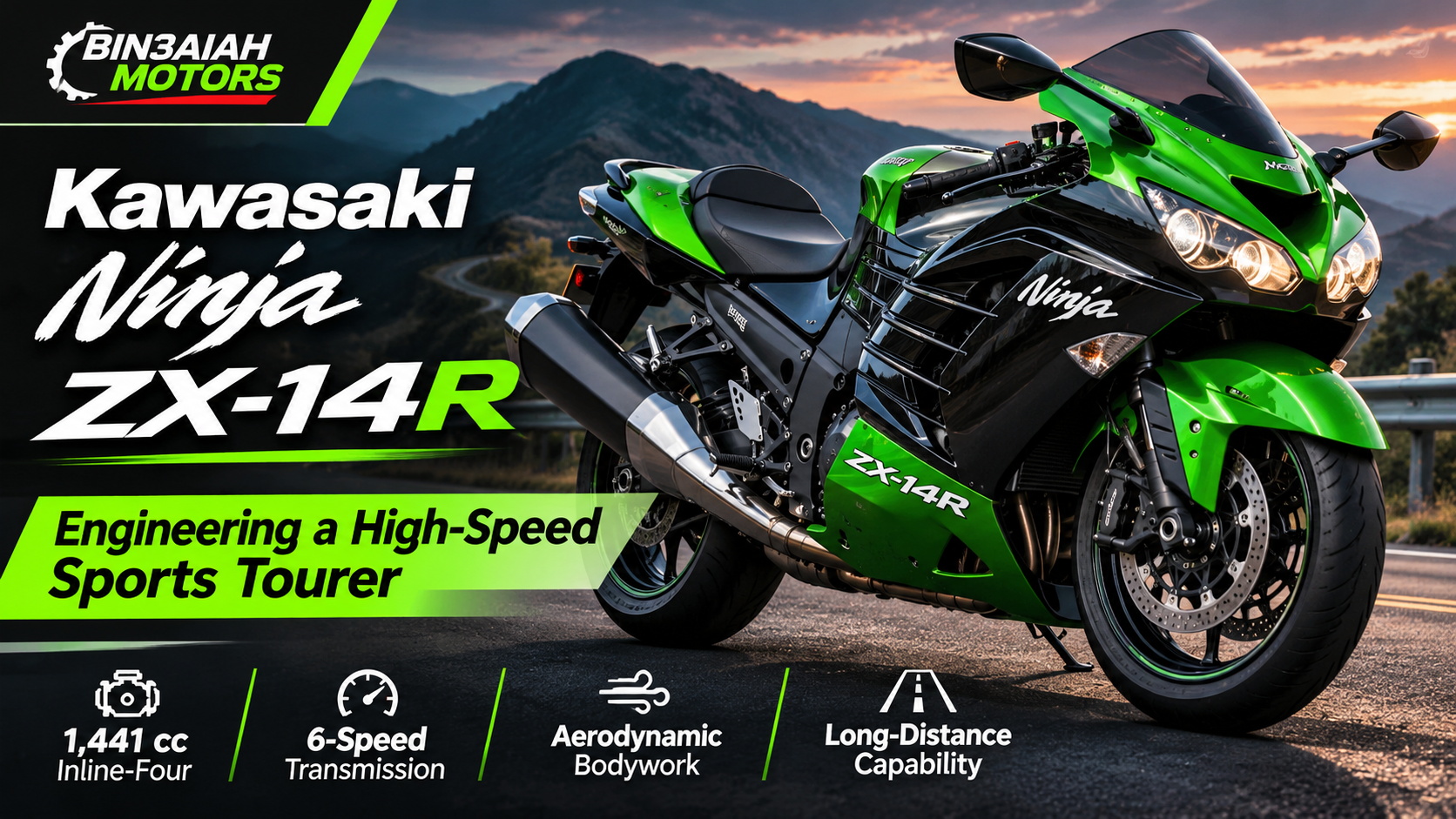
Kawasaki Ninja ZX-14R: Engineering a High-Speed Sports Tourer
Exceptional engine capacity. Sophisticated aerodynamics. Effortless acceleration.

The Kawasaki Ninja ZX-14R represents a distinctive approach to high-performance motorcycling. Combining a massive inline-four engine, aerodynamic bodywork and a long, stable chassis, it delivers remarkable acceleration while remaining capable of covering long distances.
Although Kawasaki classifies the ZX-14R as a supersport motorcycle, its spacious riding position, substantial fuel capacity and powerful midrange make it attractive to experienced sport-touring enthusiasts.
Engine
Cylinders
Transmission
Fuel Capacity
1. History and Development
The original Kawasaki Ninja ZX-14, also known as the ZZR1400 in several international markets, arrived in 2006. It was developed to compete in the large-displacement performance motorcycle segment, where the Suzuki Hayabusa was already an established benchmark.
For the 2012 model year, Kawasaki introduced the extensively revised ZX-14R. Engine displacement increased from 1,352 cc to 1,441 cc, accompanied by improvements to engine performance, chassis engineering and electronic rider assistance.
The result was a motorcycle capable of delivering substantial power without sacrificing the smoothness required for everyday riding.
2. Technical Specifications
| Specification | ZX-14R ABS |
|---|---|
| Engine configuration | Liquid-cooled inline-four |
| Displacement | 1,441 cc |
| Valve system | DOHC, 16 valves |
| Bore × stroke | 84 × 65 mm |
| Compression ratio | 12.3:1 |
| Transmission | 6-speed |
| Final drive | Chain |
| Frame | Aluminum monocoque |
| Front suspension | 43 mm inverted fork |
| Rear suspension | Uni-Trak linkage system |
| Front brakes | Dual 310 mm discs, Brembo M50 calipers |
| Front tire | 120/70 ZR17 |
| Rear tire | 190/50 ZR17 |
| Fuel capacity | Approximately 22 liters |
| Wheelbase | Approximately 1,480 mm |
| Seat height | Approximately 800 mm |
| Curb weight | Approximately 269 kg |
Specifications are representative of the later ZX-14R ABS configuration. Equipment and figures may vary by model year and market.
3. Engineering the 1,441 cc Engine
The heart of the Ninja ZX-14R is its large-capacity, naturally aspirated four-cylinder engine. Unlike smaller supersport engines that rely heavily on high rotational speeds, the Kawasaki’s displacement provides substantial torque across a broad operating range.
Large-displacement advantage
The 84 mm cylinder bore and 65 mm piston stroke produce a relatively oversquare engine configuration. This architecture supports large valve areas while allowing the engine to operate at elevated rotational speeds.
DOHC cylinder head
Two overhead camshafts operate sixteen valves, enabling efficient intake airflow and exhaust gas evacuation. Combined with electronic fuel injection, this design supports smooth combustion and responsive acceleration.
Ram-air induction
The front-facing intake channels air toward the engine. At higher speeds, airflow pressure can increase the quantity of air available to the intake system, supporting engine output.
Engine balancing
Balancing mechanisms help reduce unwanted vibration, improving rider comfort during sustained highway operation.
4. Aerodynamics and Bodywork

The ZX-14R’s distinctive appearance is closely connected to its aerodynamic requirements. Its broad fairing, sculpted front section and integrated lighting create a streamlined exterior.
- Front fairing: Directs airflow around the motorcycle and rider.
- Windscreen: Reduces direct wind exposure.
- Integrated air intake: Supplies the ram-air system.
- Side fairings: Manage airflow around mechanical components.
- Contoured tail: Helps shape airflow toward the rear.
Aerodynamic efficiency becomes increasingly important as speed rises because aerodynamic drag increases approximately with the square of velocity under comparable conditions.
Engineering Insight
The power required to overcome aerodynamic drag increases approximately with the cube of speed. This is why bodywork development is especially important on powerful motorcycles.
5. Aluminum Monocoque Chassis
Rather than relying on a conventional exposed twin-spar frame, the ZX-14R uses a hollow aluminum monocoque structure positioned above and around the engine.
The engine contributes to structural rigidity as a stressed member. This arrangement allows Kawasaki to integrate major mechanical components into a relatively compact structural package.
Its long wheelbase supports straight-line stability and predictable behavior under acceleration. However, the motorcycle’s substantial size and mass require more effort during parking and tight low-speed maneuvers.
6. Suspension and Braking
The front suspension uses an inverted fork, while the rear employs Kawasaki’s Uni-Trak linkage arrangement. Suspension adjustment allows experienced riders to configure the motorcycle for different loads and riding conditions within manufacturer recommendations.
Later versions feature Brembo M50 radial-mounted monobloc front brake calipers and twin 310 mm brake discs. ABS helps reduce the likelihood of wheel lock during braking.
These systems are particularly important because the motorcycle combines significant mass with considerable performance potential.
7. Electronic Rider Assistance
- Kawasaki Traction Control (KTRC): Helps manage excessive rear-wheel slip.
- Power modes: Allow selection of different engine output characteristics.
- ABS: Assists braking control.
- Slipper clutch: Helps manage back torque during downshifts.
- Economical riding indicator: Provides feedback about fuel-efficient operation.
Electronic assistance complements rider skill but cannot eliminate the risks associated with excessive speed, poor road conditions or inappropriate riding decisions.
8. Performance and Power Delivery

The ZX-14R is renowned for its strong acceleration and broad torque delivery. Its large engine can provide substantial overtaking performance without requiring frequent downshifts.
The six-speed gearbox, stable chassis and aerodynamic design work together to create a refined high-performance experience. Actual acceleration and maximum speed depend on the model, electronic limitations, environmental conditions and testing methodology.
Maximum-performance testing belongs exclusively in controlled, authorized environments.
9. Long-Distance Sport Touring
Despite its performance-oriented engineering, the Ninja ZX-14R offers several features that make it suitable for longer journeys.
- Substantial fuel tank capacity.
- Relatively spacious rider accommodations.
- Strong midrange torque for highway cruising.
- Full fairing for wind protection.
- Smooth four-cylinder engine operation.
- Passenger seating capability.
However, it is not a dedicated touring motorcycle. Riders may need additional luggage equipment, and its forward-leaning riding position can become tiring during extended journeys.
10. ZX-14R vs. Suzuki Hayabusa
| Feature | ZX-14R | Hayabusa |
|---|---|---|
| Engine | 1,441 cc | 1,340 cc |
| Configuration | Inline-four | Inline-four |
| Induction | Naturally aspirated | Naturally aspirated |
| Frame design | Aluminum monocoque | Aluminum twin-spar |
| Character | Large-displacement muscle | Aerodynamic hypersport |
Both motorcycles combine high-performance engines with aerodynamic design and highway capability. Their different chassis architectures and engine capacities reflect distinct engineering approaches to the same broad category.
11. Advantages and Disadvantages
Advantages
- Exceptionally strong engine
- Broad torque delivery
- Stable chassis
- Effective wind protection
- Premium braking equipment on later models
- Distinctive styling
Disadvantages
- Heavy at low speeds
- Potentially high fuel consumption
- Performance-oriented tire wear
- Limited standard luggage capacity
- Engine heat in slow traffic
- Unsuitable for inexperienced riders
12. Maintenance Considerations
Maintaining a motorcycle with this level of performance requires regular attention to critical components.
- Engine oil and filter replacement.
- Chain inspection, lubrication and adjustment.
- Tire condition and inflation pressure.
- Brake pads, discs and fluid.
- Coolant and cooling-system condition.
- Valve clearance inspections according to the service schedule.
Always follow the owner’s manual applicable to the motorcycle’s model year and market.
13. Frequently Asked Questions
Is the Kawasaki Ninja ZX-14R turbocharged?
No. The standard factory ZX-14R uses a naturally aspirated engine with ram-air induction.
Is the ZX-14R suitable for beginners?
No. Its power, weight and performance make it more appropriate for experienced riders.
Is the ZZR1400 the same as the ZX-14R?
ZZR1400 is a name used in several international markets for the same motorcycle family, although specifications can differ.
Can the ZX-14R be used for touring?
Yes. Its engine refinement, wind protection and fuel capacity make it capable of sport touring, especially with appropriate accessories.
Is the ZX-14R supercharged like the Ninja H2?
No. The Ninja H2 uses a supercharged engine, while the ZX-14R relies on large displacement and natural aspiration.
Conclusion
The Kawasaki Ninja ZX-14R demonstrates how large-displacement engine engineering, aerodynamic development and chassis design can produce a motorcycle with both extraordinary performance and practical long-distance capabilities.
Its 1,441 cc inline-four engine remains the defining feature, supported by sophisticated braking equipment, electronic assistance and an innovative aluminum monocoque structure.
For experienced motorcyclists interested in the engineering behind high-performance road machines, the ZX-14R remains a fascinating example of Japanese motorcycle development.