
Views: 0
Yamaha YZF-R1: The Evolution of a Superbike
BIN3AIAH MOTORS | MOTORCYCLE HISTORY | SUPERBIKES


Few motorcycles have transformed the superbike world as dramatically as the Yamaha YZF-R1. Introduced in 1998, the R1 redefined expectations for power, weight, handling, and rider connection. Almost three decades later, its crossplane engine, MotoGP-inspired design, and championship-winning pedigree continue to make it one of the most recognizable superbikes ever built.
From a lightweight road-focused machine to an advanced, electronics-equipped track weapon, the R1’s evolution tells the story of modern motorcycle engineering.
1. The beginning: 1998–2001

1998 — A superbike revolution
Yamaha introduced the original R1 with a 998cc inline-four engine, a compact stacked transmission layout and a lightweight aluminum Deltabox frame.
Its approximately 150 PS output and 177 kg dry weight created a remarkable power-to-weight combination. Its agile chassis also made the bike feel smaller than earlier large-capacity sports motorcycles.
The original R1 was designed primarily to deliver exceptional performance on winding roads rather than simply chasing racetrack lap records. Its compact architecture helped Yamaha combine a short wheelbase with a relatively long swingarm, improving both agility and traction.
The 2000 update refined aerodynamics, engine characteristics, and handling without abandoning the original concept.
Yamaha Motor
+2
2. Fuel injection and refinement: 2002–2003

For 2002, Yamaha replaced the original carburetors with electronic fuel injection. A redesigned Deltabox frame increased rigidity, while updated bodywork created a sharper and more modern appearance.
The result was a motorcycle with more precise fuel delivery, improved chassis behavior, and greater refinement. The 2002 generation also introduced distinctive LED rear lighting.
This was an important transition: superbikes were becoming increasingly sophisticated machines rather than simply powerful motorcycles.
Yamaha Motor Co., Ltd.
+1
3. A new performance era: 2004–2006

The 2004 R1 represented a comprehensive redesign. Its under-seat dual exhausts became a signature styling feature, while radial-mount front brake calipers improved high-performance braking capability.
The new engine produced approximately 172 PS, a substantial increase over the previous generation. Yamaha also revised the frame and suspension to balance greater power with precise handling.
Special editions, including the 2006 R1 SP, demonstrated Yamaha’s growing focus on exclusive, premium suspension and chassis components.
Yamaha Motor Co., Ltd.
+2
4. Electronics enter the picture: 2007–2008

The 2007 generation introduced Yamaha Chip Controlled Throttle (YCC-T), its electronic ride-by-wire throttle system, as well as Yamaha Chip Controlled Intake (YCC-I), which adjusted intake funnel length to optimize engine performance.
Another major engineering change was the move from Yamaha’s traditional five-valve-per-cylinder configuration to a four-valve design featuring lightweight titanium intake valves.
These developments gave the R1 greater control over throttle response and engine breathing, foreshadowing the electronics that would later define modern superbikes.
Yamaha Motor
+1
5. The crossplane revolution: 2009–2014

In 2009, Yamaha introduced one of the most significant innovations in R1 history: the crossplane crankshaft.
Inspired by the company’s YZR-M1 MotoGP racing technology, the new crankshaft configuration changed how the inline-four delivered its power. Its distinctive firing character helped riders better sense and control rear-wheel traction.
The crossplane engine also produced the deep, irregular exhaust note that became an R1 trademark.
The 2012 update introduced more advanced electronic rider assistance, including traction control, marking another major step toward digitally managed superbike performance.
Yamaha Motor Co., Ltd.
+1
6. Born for the racetrack: 2015–2019

The 2015 R1 marked a fundamental philosophical shift. Yamaha moved from developing a superbike primarily for fast, winding roads toward creating one optimized for racing circuits.
Its 997cc crossplane four-cylinder engine delivered approximately 200 PS, while a sophisticated six-axis inertial measurement unit supported advanced rider-control systems.
These included lean-sensitive traction control, slide control, lift control, launch control, and sophisticated braking assistance.
Yamaha also introduced the premium R1M, featuring advanced electronic Öhlins suspension, carbon-fiber bodywork, and additional track-oriented equipment.
The 2015 generation was effectively a street-legal race machine, heavily influenced by Yamaha’s MotoGP program.
Yamaha Motor Co., Ltd.
+1
7. Aerodynamics and precision: 2020–2024

For 2020, Yamaha refined the R1’s engine, aerodynamic efficiency, and electronic systems.
Updates included revised intake and valvetrain components, smoother bodywork integration, and refinements designed to make its considerable performance more accessible and predictable.
The R1M continued to provide a premium alternative for dedicated track riders, combining electronic suspension with advanced riding technology.
Yamaha Motor Co., Ltd.
8. The modern R1: 2025–2026

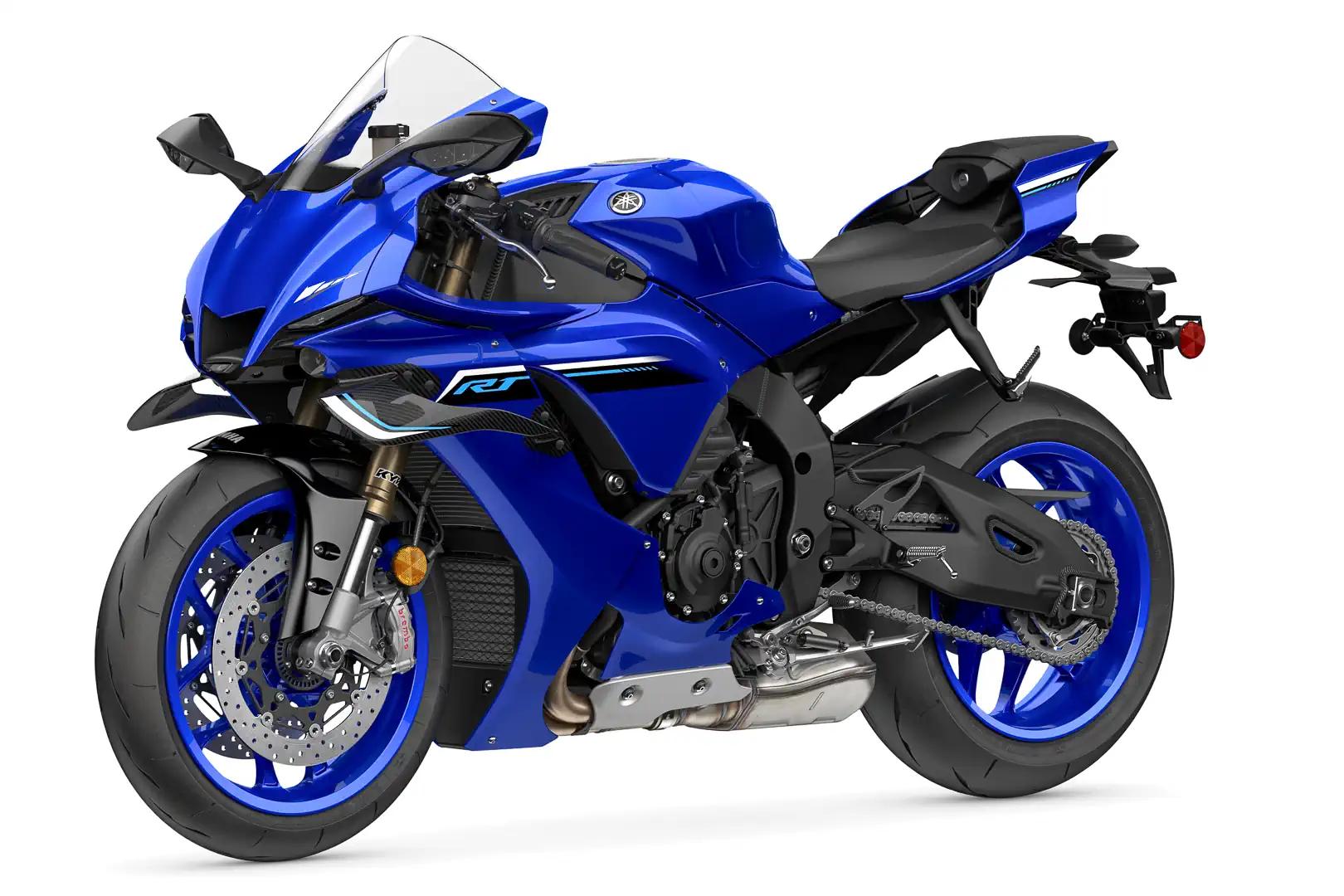
The 2025 model introduced aerodynamic winglets inspired by Yamaha’s racing experience, alongside important braking and suspension updates.
The standard R1 received updated KYB front suspension and Brembo Stylema front brake calipers, improving stability and control during demanding riding.
In 2026, Yamaha continued selling the road-going R1 in selected markets, including Japan and the United States. A 70th Anniversary Edition celebrated Yamaha’s racing heritage with distinctive red-and-white styling.
Yamaha also announced a dedicated race-base R1 for 2027 delivery, demonstrating its continued commitment to track and competition use.
ヤマハ発動機株式会社
+3
Yamaha YZF-R1 evolution timeline
| Year | Major milestone |
|---|---|
| 1998 | Original 998cc R1 launches |
| 2000 | Improved handling and aerodynamics |
| 2002 | Fuel injection and revised frame |
| 2004 | Major redesign and under-seat exhausts |
| 2007 | Ride-by-wire throttle and four-valve engine |
| 2009 | Crossplane crankshaft introduced |
| 2012 | Traction control added |
| 2015 | MotoGP-inspired redesign and R1M launch |
| 2020 | Engine, aerodynamic and electronics refinements |
| 2025 | Aerodynamic winglets, upgraded brakes and suspension |
| 2026 | 70th Anniversary Edition and continued racing development |
The engineering that makes the R1 special

Crossplane engine
The distinctive crankshaft layout enhances the rider’s connection with rear-wheel traction.

Deltabox chassis
A lightweight aluminum frame architecture designed for precise handling and stability.

Advanced suspension
High-performance suspension systems help riders maintain control during aggressive cornering and braking.

Race-inspired aerodynamics
Modern winglets enhance front-end stability during high-speed riding.
Racing heritage and championship success
The R1’s racing achievements are central to its legacy. Its success extends beyond showroom performance to world-class motorcycle competition.
One of its defining achievements came in 2021, when Toprak Razgatlıoğlu won the World Superbike Championship riding a Yamaha R1.
Yamaha has also achieved major success in endurance racing, including multiple Suzuka 8 Hours victories. In 2025, Katsuyuki Nakasuga secured his 13th Japanese JSB1000 title aboard the R1.
The machine remained active in international World Superbike and endurance racing during 2026.
Yamaha Motor
+2
Why the Yamaha R1 remains legendary
The Yamaha YZF-R1 has consistently demonstrated that exceptional superbike performance is about more than maximum horsepower. Its significance lies in the relationship between engine character, chassis geometry, electronic assistance, aerodynamic efficiency and rider confidence.
The original 1998 model redefined how compact and agile a 1,000cc sport motorcycle could be. The 2009 crossplane generation gave the R1 a distinctive mechanical identity. The 2015 redesign transformed it into an uncompromising track-oriented machine, while subsequent versions refined its speed and control.
Nearly three decades after its launch, the R1 remains a benchmark of Japanese superbike engineering and one of the most influential motorcycles in the history of high-performance riding.
Publication information — Bin3aiah Motors
SUGGESTED WORDPRESS SETTINGS
Website: motors.bin3aiah.net
SEO title: Yamaha YZF-R1: The Evolution of a Superbike (1998–2026)
URL slug: yamaha-yzf-r1-evolution-history
Meta description: Discover the Yamaha YZF-R1’s evolution from 1998 to 2026, including its crossplane engine, MotoGP technology, superbike generations and racing history.
Focus keyword: Yamaha YZF-R1 evolution
Secondary keywords: Yamaha R1 history, Yamaha R1 generations, Yamaha R1 crossplane engine, Yamaha superbike, Yamaha R1M
Category: Motorcycles / Superbikes / Yamaha
Post status: Article prepared; not published.
Research and media references
Official sources used for historical and contemporary model verification include Yamaha R-Series History, 25 Years of R1, and Yamaha’s 2026 R1 Announcement.
For the final WordPress publication, use authorized or appropriately licensed photography with image credits, alt text and a verified featured image. The photographs displayed above are visual references, not confirmed publication-licensed assets.