
Views: 8
Honda CBX1000: Inside the Legendary Six-Cylinder Motorcycle
Motorcycle History | Engineering | Honda Classics
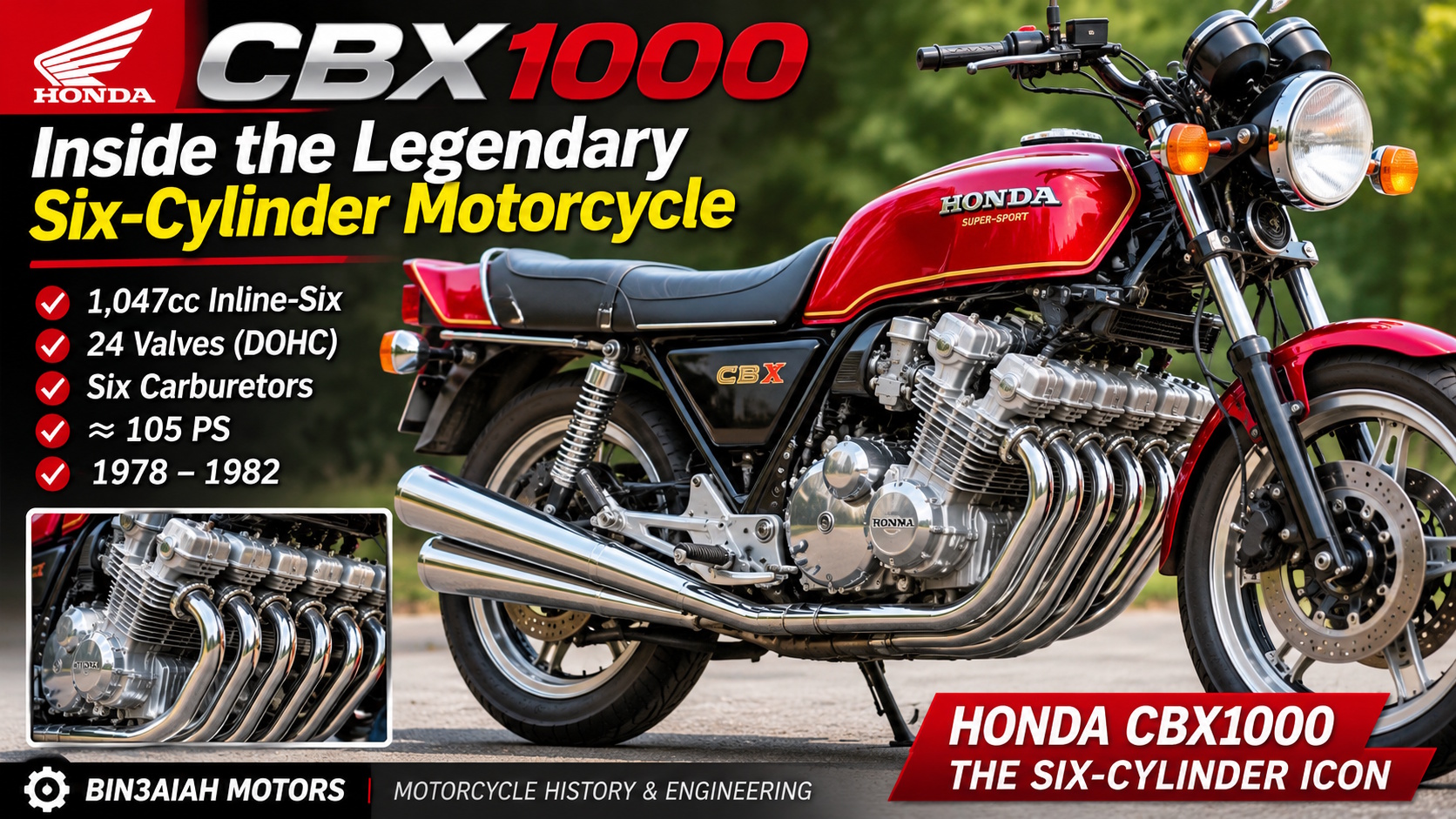
The Honda CBX1000 is one of the most extraordinary motorcycles in history. Introduced in 1978 for the 1979 model year, it combined Grand Prix-inspired engineering, a 1,047cc inline-six engine, 24 valves, six carburetors and one of the most recognizable exhaust notes ever heard on a production motorcycle.

The Birth of a Six-Cylinder Legend
Honda had already mastered exotic multi-cylinder racing engines during the 1960s. Its celebrated six-cylinder Grand Prix machines helped inspire a road motorcycle that would demonstrate the company’s technical ambition. Engineer Shoichiro Irimajiri, associated with Honda’s racing engine development, played a central role in the CBX project.
Rather than follow the conventional inline-four superbike formula, Honda produced a transverse inline-six that combined exceptional smoothness, high engine speed and striking mechanical design. The result became an instant technological icon.
Honda CBX1000 Technical Specifications
| Specification | Details |
|---|---|
| Manufacturer | Honda, Japan |
| Production | 1978–1982 |
| Engine | 1,047cc, four-stroke, transverse inline-six |
| Cooling | Air-cooled |
| Valvetrain | DOHC, 24 valves |
| Bore × Stroke | 64.5 × 53.4 mm |
| Fuel Delivery | Six Keihin carburetors |
| Maximum Power | Approximately 105 bhp at 9,000 rpm (early specification) |
| Maximum Torque | Approximately 86 Nm at 8,000 rpm (early specification) |
| Gearbox | Five-speed manual |
| Final Drive | Chain |
| Brakes | Dual front discs, single rear disc |
| Top Speed | Around 200–225 km/h, depending on version and conditions |
Specifications vary by model year and market. Later sport-touring versions had different equipment and power ratings.
Inside the Incredible Inline-Six Engine

Six Cylinders Across the Frame
The CBX’s defining feature is its transverse six-cylinder engine. Six pistons operating within a naturally balanced inline configuration produce remarkably smooth power delivery. Honda carefully packaged the powerplant to reduce its overall width, placing some auxiliary equipment behind the cylinders.
Double Overhead Camshafts and 24 Valves
Four valves per cylinder provide the engine with 24 valves in total. Two overhead camshafts operate the valve gear, supporting efficient breathing and the high-revving characteristics for which the CBX became famous.
Six Carburetors
Each cylinder receives its mixture through an individual Keihin carburetor. This sophisticated arrangement contributes to throttle response but also introduces maintenance complexity. Correct synchronization and clean fuel passages are particularly important on surviving examples.
The Legendary Six-Cylinder Sound
Few motorcycles have an exhaust note comparable to the CBX. At low rpm the engine sounds refined and mechanically rich. As engine speed rises, its six cylinders produce an increasingly intense, high-pitched howl that has become one of the motorcycle’s most celebrated features.
Performance and Riding Character
With approximately 105 bhp in its early specification, the CBX delivered exceptional performance for the late 1970s. Its engine rewarded riders with smooth acceleration, a broad power delivery and an exciting top-end rush. Although the engine was technologically advanced, the original frame, suspension and tires reflected the limitations of the period.
Compared with modern sport motorcycles, the CBX feels substantial and demands a more deliberate approach to cornering and braking. Its distinctive appeal comes from the experience of riding a powerful, mechanically sophisticated classic rather than achieving modern lap times.

Model Evolution: 1979 to 1982
1979: The Original Super Sport
The original CBX emphasized performance and its remarkable exposed engine. It featured a traditional naked-bike appearance, twin rear shock absorbers, round headlight and minimal bodywork. Its powerful inline-six made it one of the most impressive production motorcycles of its era.
1980: Refinements
Honda revised the CBX with detail changes intended to improve usability and reliability. Changes differed between markets, while the motorcycle retained its basic twin-shock layout and six-cylinder identity.
1981: The Sport-Touring Transformation
For 1981, Honda repositioned the CBX as a sport-tourer. The revised motorcycle featured a large front fairing, improved touring equipment and a Pro-Link rear monoshock suspension system. This transformation emphasized stability and long-distance comfort.
1982: The Final Generation
The final CBX continued the fairing-equipped sport-touring design. Although production concluded after a short run, the motorcycle had already established a reputation far greater than its sales volume suggested.

Honda CBX1000: Advantages and Disadvantages
Advantages
- Unforgettable six-cylinder engine sound and smoothness.
- Extraordinary mechanical appearance and distinctive styling.
- Strong performance for its original era.
- Important connection to Honda’s Grand Prix engineering heritage.
- Strong appeal among enthusiasts and classic motorcycle collectors.
- A unique riding experience that modern motorcycles rarely reproduce.
Disadvantages
- Six carburetors make maintenance and tuning more demanding.
- Considerable weight compared with many contemporary sport bikes.
- Early suspension and chassis equipment can feel dated.
- Original exhaust components and specialist replacement parts may be expensive.
- Fuel consumption and servicing requirements can be substantial.
- Older examples may require electrical, brake and fuel-system restoration.
Honda CBX1000 vs Historic Rivals
Kawasaki Z1300: Another spectacular inline-six motorcycle, the larger 1,286cc Kawasaki emphasized substantial power, refinement and touring ability.
Suzuki GS1000: A highly capable inline-four superbike offering a more conventional balance of performance, handling and mechanical simplicity.
Benelli 750 Sei: An important earlier production six-cylinder motorcycle, proving that the configuration had reached the road before the Honda CBX.
The CBX’s enduring attraction was not simply its cylinder count. Its sophisticated cylinder head, sensational exhaust note and racing-inspired character helped establish its lasting reputation.
Buying a Honda CBX1000 Today
Condition, originality, maintenance records and model year are critical when considering a classic CBX.
- Engine: Check compression, leaks, unusual mechanical sounds and valve-service history.
- Carburetors: Inspect for blocked passages, poor synchronization and fuel leakage.
- Exhaust: Look for corrosion and verify whether the system is original.
- Chassis: Inspect the frame, steering bearings, suspension components and wheels.
- Brakes: Check calipers, discs, hoses and master cylinders.
- Electrical system: Examine charging performance, switches and wiring connections.
- Documentation: Confirm frame and engine numbers, ownership history and restoration records.
A specialist inspection is strongly recommended. A well-maintained CBX can be deeply rewarding, but neglected examples may require extensive restoration.
Why the CBX1000 Still Matters
The Honda CBX1000 represents a remarkable era of engineering experimentation. It was a complex, expensive and ambitious answer to the question of how far a production motorcycle engine could be developed.
Modern sport motorcycles are faster, lighter and more efficient, but few offer the same visual and acoustic spectacle. Its six-cylinder engine continues to symbolize a moment when manufacturers were willing to pursue extraordinary mechanical solutions simply because they could.
The Honda CBX1000 remains one of motorcycling’s greatest engineering statements: six cylinders, 24 valves and a personality that has become truly legendary.
Watch the Honda CBX1000
Watch: Honda CBX1000 Six-Cylinder Riding Feature on YouTube
References and Image Credits
- Honda Classics — CBX1000 History
- CBX Riders Club UK — Model History
- Rider Magazine — CBX Retrospective
- Photo: SG2012, CC BY 2.0
- Photo: Rikita, CC BY-SA 3.0
- Photo: ronsaunders47, CC BY-SA 2.0
- Photo: Rainmaker47, CC BY-SA 3.0
Image licenses: CC BY 2.0, CC BY-SA 2.0, and CC BY-SA 3.0. Images are embedded without modifications; comply with the respective license terms if adapting them.